REVIEW · HISTORICAL TOURS
Split: Private Walking Tour in the Historical Town Center
Book on GetYourGuide →Operated by Sanja - Tour Guide in Split · Bookable on GetYourGuide
Split’s Palace maze tells its story fast. In just 105 minutes, you move through Roman power, medieval streets, and later layers of rule without feeling like you’re reading a textbook on your feet. The big win here is the private format and a licensed guide who ties the architecture to real life.
I especially like how the tour hits the must-sees in a smart order: Diocletian’s Palace first, then the central squares outside the palace walls. You also get the kind of guidance that helps you keep exploring after the walk, including tips you can use on your own.
One consideration: this walking tour is not suitable for wheelchair users. And while the main sights are included, the Palace Substructures/Basements require an entrance fee.
In This Review
- Key highlights you’ll feel immediately
- Entering Split on the Riva: Where the tour starts (and why it matters)
- Riva Promenade orientation and your first big takeaway
- Diocletian’s Palace: the Roman core plus medieval neighborhoods
- What you’ll actually look for inside
- The Substructures/Basements: seeing the palace from below
- Peristil Square: a power space that still works today
- Saint Domnius Cathedral (Mausoleum): where Roman and later Split meet
- Jupiter’s Temple / Baptistery: an external look that still teaches
- Golden Gate and the palace walls: the city’s boundaries in stone
- People’s Square and the rule-by-square idea
- Fruit Square, Pjaca, and Prokurative: trade, politics, and daily life
- A small former Jewish ghetto and an active synagogue
- Ending at the sea: Riva promenade finish and what to do next
- Price and value: $153 per group up to 15 (and what that means for you)
- The guide makes the difference: why Sanja’s style stands out
- Who this tour suits best (and who should skip it)
- Should you book this Split private walking tour?
- FAQ
- Where do we meet for the tour?
- How long is the walking tour?
- Is this a private tour?
- What language is the guide available in?
- What’s included in the price?
- Are entrance fees included for everything?
- Is Jupiter’s Temple included?
- Is the tour suitable for wheelchair users?
- What is the cancellation policy?
Key highlights you’ll feel immediately

- Private group pace that lets you ask questions without rushing
- Diocletian’s Palace focus, from the oldest Roman core to medieval additions
- Substructures/Basements visit (paid entrance) so you see what’s under the palace
- Peristil, Cathedral of Saint Domnius, and major gates in one organized route
- Venetian, French, Austro-Hungarian, and Yugoslav-era context tied to specific squares
- End at Riva promenade so you can naturally continue your day by the sea
Entering Split on the Riva: Where the tour starts (and why it matters)
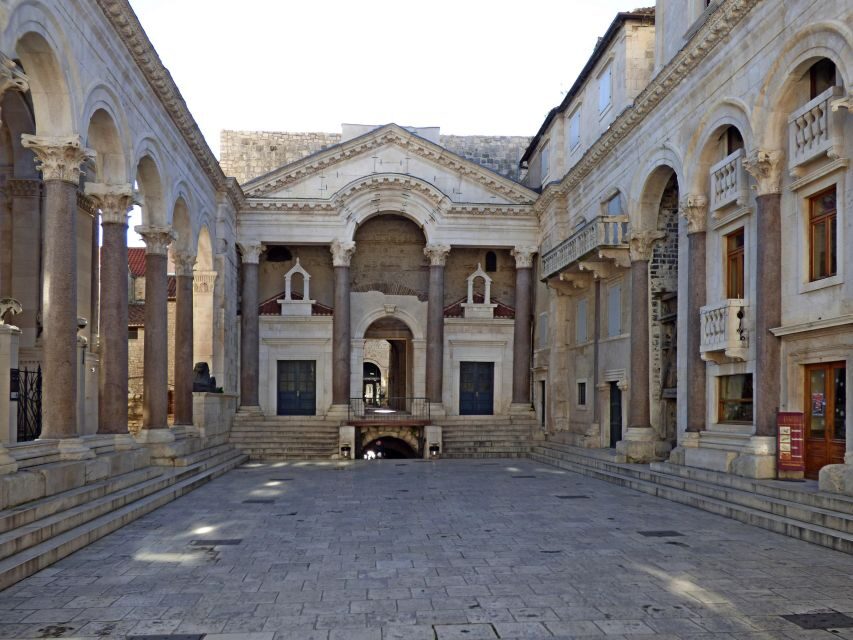
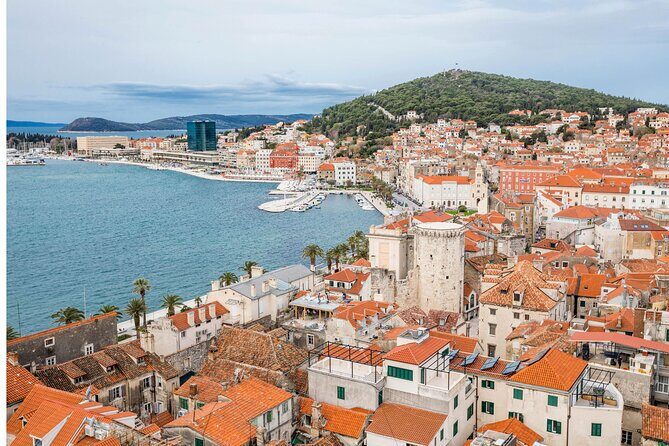
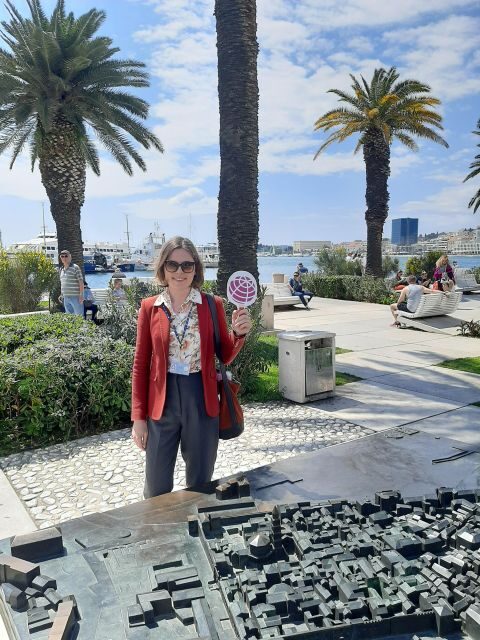
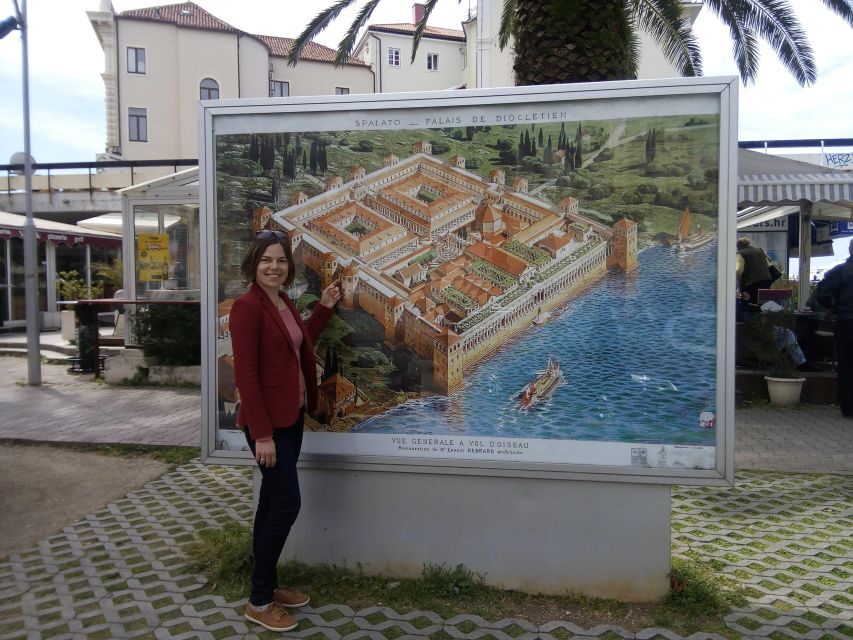
The meeting point is on the Riva promenade by the sea, at the bronze model of the historical core. It sits in front of the south entrance to Diocletian’s Palace, which is a clever setup because you’re oriented right where the city’s story begins.
This location also keeps you from wasting time with vague “meet by the fountain” confusion. You’re right next to the palace walls, so the walk feels like one continuous transition—from orientation, to discovery, to a smooth finish back at the waterfront.
You can also read our reviews of more walking tours in Split
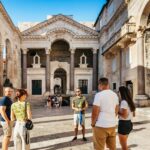
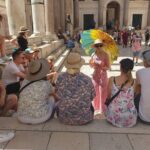

Riva Promenade orientation and your first big takeaway
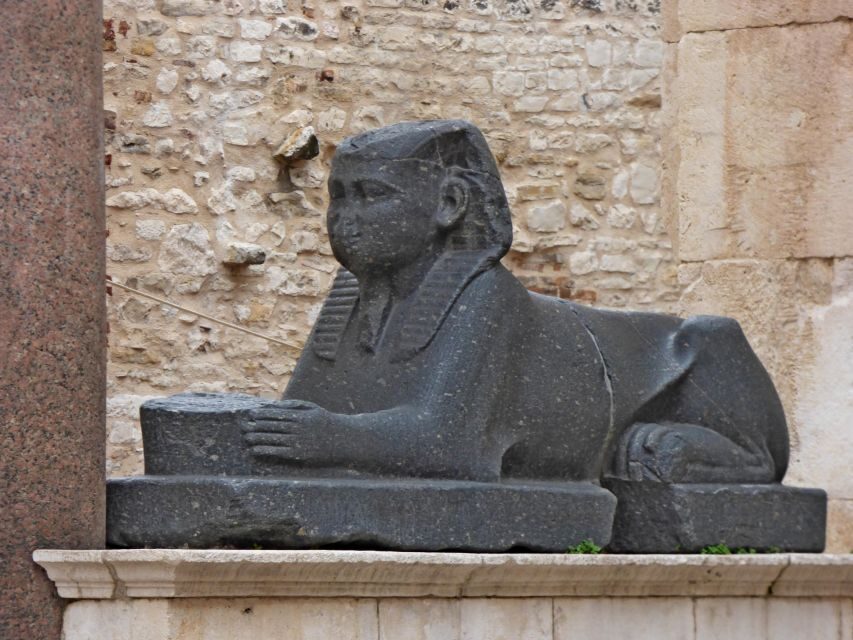
Your route begins with a guided stroll through streets and squares for about 1:45. That duration is long enough to matter, but short enough that you’ll still have energy to wander later on your own.
You’ll also learn how to read Split visually. The guide doesn’t just name buildings; you’ll start noticing why streets bend the way they do, why certain spaces feel like power centers, and how later rulers left their fingerprints on everyday life.
Diocletian’s Palace: the Roman core plus medieval neighborhoods
The heart of the tour is the 4th-century Palace of the Roman emperor Diocletian—the oldest part of Split. You don’t just see the palace from the outside. You walk through it, and you’ll notice something that makes Split unusual: a small medieval neighborhood grew up inside the Roman structure.
That contrast is the point. Roman walls are massive and strategic; medieval life is tight, human-scale, and lived-in. Watching those two worlds overlap helps you understand why this place still feels active instead of frozen in time.
What you’ll actually look for inside
The guided visit includes key elements like:
- the palace walls with major gates
- the main square, Peristil
- the spaces connected to the Mausoleum / St. Domnius’s Cathedral
- the areas tied to Jupiter’s Temple / Baptistery (external visit, no entrance fee)
A drawback of any palace you walk through is that it can feel dense if you’re just “checking boxes.” The private guide format helps because you can slow down when something catches your eye—without losing the overall flow.
The Substructures/Basements: seeing the palace from below
One of the standout segments is the Substructures (Basements), located under the palace. These aren’t included in the price, so you’ll pay the entrance fee on site. Still, it’s often the best “wow” per minute because it changes your understanding of the whole complex.
When you see the basement level, the palace stops looking like a single monumental shell. You start to understand it as an engineered system—support spaces, functions tucked underneath, and how life could operate at different levels.
If you’re the type who likes places that have layers you can physically stand inside, don’t skip this part just because it costs extra. The tour is set up so this entrance fits naturally into the bigger palace story.
You can also read our reviews of more private tours in Split




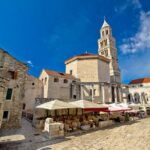

Peristil Square: a power space that still works today
Next you spend time at Peristil, the palace’s main square. This is one of those spaces where the architecture does the talking. The layout pulls your gaze inward, and the scale makes it feel like you’ve stepped into the center of authority.
Even if you only have 10 minutes here, it’s time used well because you’re learning what this space was meant to be. It’s not just pretty stone—Peristil is about control, movement, and the way rulers shaped public presence.
Saint Domnius Cathedral (Mausoleum): where Roman and later Split meet
You’ll also visit the Mausoleum / St. Domnius’s Cathedral. This stop is important because it connects the Roman era to religious life that kept going long after the original imperial story ended.
In a short tour window, the guide’s job is to help you notice the shift in purpose. You’re looking at a place built with one mindset, later re-used and reinterpreted with another. It’s a practical way to understand how long-standing buildings get repurposed when cities change.
Jupiter’s Temple / Baptistery: an external look that still teaches
You’ll pass by Jupiter’s Temple / Baptistery for an external visit—no entrance fee. That sounds like a “lesser” stop, but it works because it trains your eye.
Instead of treating it like another quick photo moment, you’ll get help reading what you can see from the outside and how it fits into the palace layout. For travelers trying to manage money and time, “external with context” is often the smartest kind of stop.
Golden Gate and the palace walls: the city’s boundaries in stone
The itinerary includes the Golden Gate area and time along the palace walls with gates. These are the kinds of details that many people walk past—because they look like walls, right?
But gates are where history shows its logic. They signal movement, protection, and access. With the guide explaining how the palace functioned as a boundary, you’ll start to understand why Split’s streets feel like they’re organized around these historic edges.
People’s Square and the rule-by-square idea
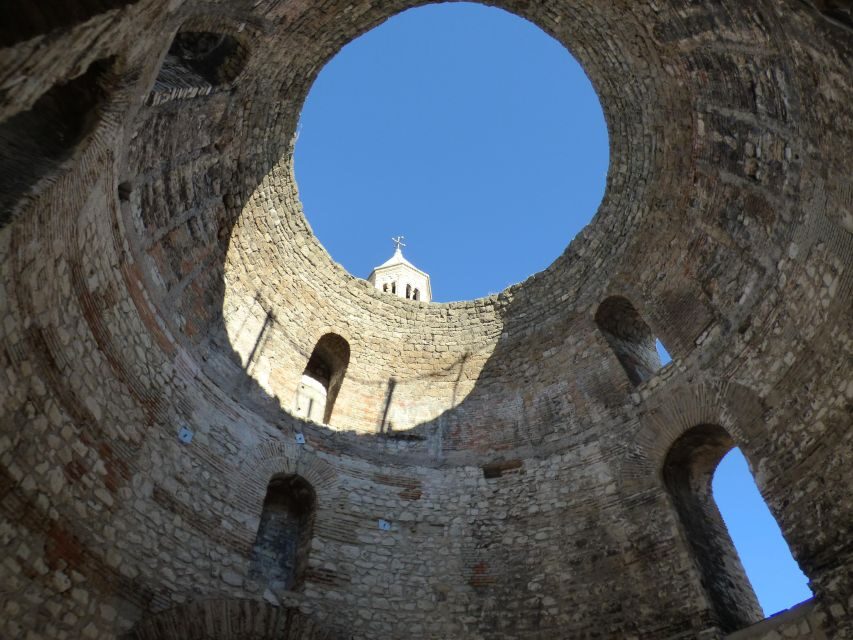
The second part of the walk takes you out into the medieval neighborhood built outside the palace. Here, the tour shifts from Roman engineering to something more political: public spaces that reflect who was in charge and how power got practiced day to day.
You’ll hit People’s Square first. Even with limited time, it’s a key moment because it sets up how you should interpret the rest of the route. Think of it as a living map of control—who influenced the city, where crowds gathered, and how the city looked when it had different priorities.
Fruit Square, Pjaca, and Prokurative: trade, politics, and daily life
You’ll also stop at famous squares including Fruit Square (Voćni trg) and Prokurative (Prokurative). The guide connects these spaces to socio-political life under later rule—Venetian, French, Austro-Hungarian, and Yugoslavian periods.
That context matters because it turns a square from a postcard into a timeline. You begin to see why certain architectural styles and urban patterns show up where they do.
And yes, the square names are fun to learn and repeat. It’s the kind of small cultural detail that makes your later independent wandering easier because you’ll recognize where you are.
A small former Jewish ghetto and an active synagogue
The route includes a look at a small former Jewish ghetto area, including a synagogue that remains active. This is one of those stops where the tone changes slightly because it’s not just about architecture—it’s about continuity.
Even if you only see a portion of the neighborhood, the guide’s explanation helps you understand why these spaces deserve respect. It’s also a useful reminder that the city’s layers aren’t only ancient. Some of the story is ongoing.
Ending at the sea: Riva promenade finish and what to do next
You finish back at the Riva promenade by the sea. That timing is practical. You’re done with the heavy “old town navigating” right when you’ve gathered enough context to move through the city on your own.
Use the guide’s tips like a personal cheat code. You’ll know what to prioritize later and what to treat as optional, depending on your interests—Roman remains, medieval streets, or the later political layers tied to each square.
It’s also a nice way to avoid the common problem of touring old towns: you leave tired and confused. Here, you leave oriented.
Price and value: $153 per group up to 15 (and what that means for you)
The price is listed as $153 per group for up to 15 people, with the walking time at about 105 minutes. That pricing can be a steal if you’re traveling with a small group, but it can also be pricey if you’re solo and paying full group cost.
Here’s the practical way to think about value:
- If you split the group cost among several people, you’re effectively paying “local guide hourly rates” for a tight route that covers the big highlights.
- If it’s just you or two people, it becomes more of a convenience buy: a private guide plus a logical route that prevents wasting time on guesswork.
One more cost reality check: the tour includes many major palace sights, but the Substructures/Basements have an entrance fee. Budget a bit extra if you want the full experience.
The guide makes the difference: why Sanja’s style stands out
The tour is led by Sanja, a licensed local guide with a Master’s degree. The best part is how smoothly the explanations connect history to what you’re seeing right now—Roman structures, medieval neighborhoods, and later rulers in specific squares.
In particular, her ability to communicate clearly comes through strongly. Several recent bookings highlight excellent French (and strong overall communication), plus a style that works well for first-time visitors—especially when you do this early and use it to steer the rest of your stay.
The private format helps too. When you can hear the guide easily and ask questions, you don’t just collect facts. You build a mental map you’ll actually use.
Who this tour suits best (and who should skip it)
This is a strong fit if you want:
- a time-efficient introduction to Split’s core sights
- a guided walk that explains the why behind the look
- help prioritizing what to explore after the tour
It may be less ideal if:
- you need wheelchair access (it’s not suitable for wheelchair users)
- you dislike walking (it’s a 105-minute pedestrian route)
- you’re trying to keep every cost at the headline price (the basement entrance is extra)
Should you book this Split private walking tour?
I’d book it if you’re visiting Split for the first time and you want a guided route through Diocletian’s Palace, the surrounding medieval area, and the key squares—without spending hours mapping it yourself. The structure is built for understanding fast: palace first, then the city outside the walls, then back to the sea.
I’d pause before booking if your priority is only one or two sights, and you’re comfortable planning on your own. In that case, a shorter or more focused visit might fit better.
FAQ
Where do we meet for the tour?
You meet on the Riva promenade by the sea at the bronze model of the historical core of the city of Split, in front of the south entrance to Diocletian’s Palace.
How long is the walking tour?
The tour lasts 105 minutes (about 1:45 hours).
Is this a private tour?
Yes. It’s a private group tour.
What language is the guide available in?
The guide is available in English, Italian, French, and Spanish.
What’s included in the price?
Included are a professional licensed local guide with a Master’s degree, the private tour, and commission/tax.
Are entrance fees included for everything?
No. Entrance fees to Diocletian’s Palace Substructures (Basements) are not included.
Is Jupiter’s Temple included?
You’ll do an external visit of Jupiter’s Temple / Baptistery, and it is described as no entrance fee.
Is the tour suitable for wheelchair users?
No. It is not suitable for wheelchair users.
What is the cancellation policy?
You can cancel up to 24 hours in advance for a full refund.