REVIEW · DIOCLETIAN'S PALACE
Walking Tour of Split and Diocletian’s Palace
Book on Viator →Operated by Ancient Tours · Bookable on Viator
Split’s palace feels like a city.
This walk is a fast, focused way to get your bearings inside Diocletian’s Palace and then connect the dots to the streets of Split. I love that the route is built around key landmarks like the Peristyle and the Golden Gate, so you understand what you’re looking at. I also like the small-group feel (up to 20), which makes it easier to ask questions while you’re standing right in the history. One possible drawback: if you’re farther back, you may struggle to hear the guide since headsets aren’t part of the setup.
You’ll be out there about 1 hour 30 minutes, with multiple departure times to match your day. And while the main stops are free to view from the outside, paid sections like parts of the substructures aren’t included, so it helps to know what you will and won’t enter.
In This Review
- Key highlights worth your attention
- Entering Split through Diocletian’s Palace’s main hub
- The Peristyle (15 minutes): what this central square teaches you
- The vestibule (5 minutes): a quick human moment inside the palace story
- Substructures walk-through (10 minutes): see the layers without the extra museum time
- Golden Gate (10 minutes): Gregory of Nin and why language matters
- Riva Harbor (15 minutes): the bronze model and the promenade connection
- Fruit’s Square (Trg Brace Radic): a Venetian citadel and Marko Marulić
- Split Synagogue (pass-by): Jewish history with no paid entry included
- Timing, group size, and how to hear the guide
- Price and value: what $48.37 buys you in real sightseeing time
- Logistics that matter on the ground in Split
- Who this tour suits best (and who should skip)
- Should you book this Split and Diocletian’s Palace walking tour?
- FAQ
- How long is the Split walking tour of Diocletian’s Palace?
- What does the tour cost?
- Is the tour offered in English?
- Is admission included?
- Which main sites are covered?
- Where does the tour start and end?
- What group size can I expect?
- Is the tour accessible if I have trouble with steps?
- How do I get the ticket?
- Can I cancel for a full refund?
Key highlights worth your attention
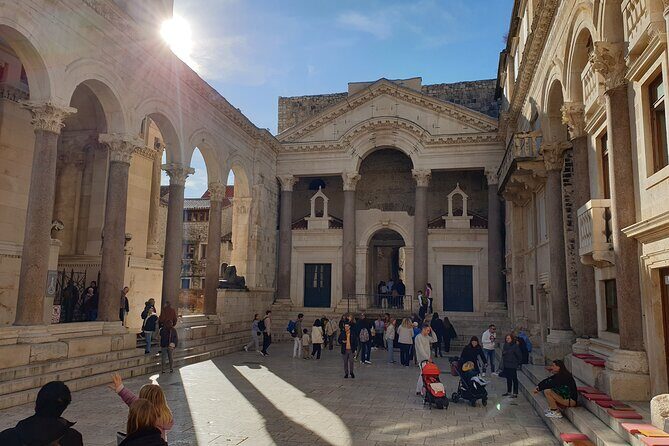
- UNESCO stop right in the middle of Split: Diocletian’s Palace is the core of the tour, not a side note.
- See the palace from the inside out: Peristyle, vestibule, substructures, and the Golden Gate are all part of the story.
- Hands-on orientation for first-timers: You’ll connect palace spaces to how Split works today.
- Small group, up to 20 people: Better chances to hear and ask questions.
- Free viewing stops plus a couple paid areas: You get a lot without paying extra at every corner.
- English-led with strong guide performance: Names like Antonella, Antonio, Mario, and Professor Marino come up often for clear storytelling.
Entering Split through Diocletian’s Palace’s main hub

Start at Peristil ulica, in the heart of Split’s old core. The tour then orbits the palace like a clock, using the Peristyle as your central reference point. If you’ve ever felt overwhelmed by palace walls and doorways that all look important, this is the cure. You learn where things connect, and you stop seeing it as random stone.
The Peristyle stop is basically the “switchboard” for the whole palace complex. From here, you can reach almost all other locations within the palace, so it’s the best place to begin your mental map. The guide’s job is to turn what looks like architecture into a readable layout, with the palace’s central role in Split’s story made clear early on.
You can also read our reviews of more walking tours in Split


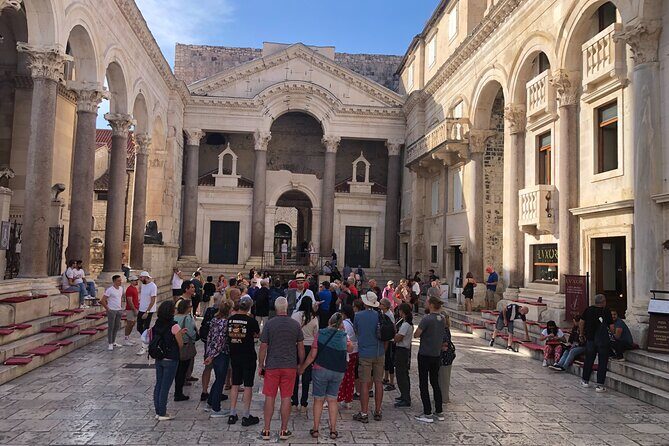
The Peristyle (15 minutes): what this central square teaches you
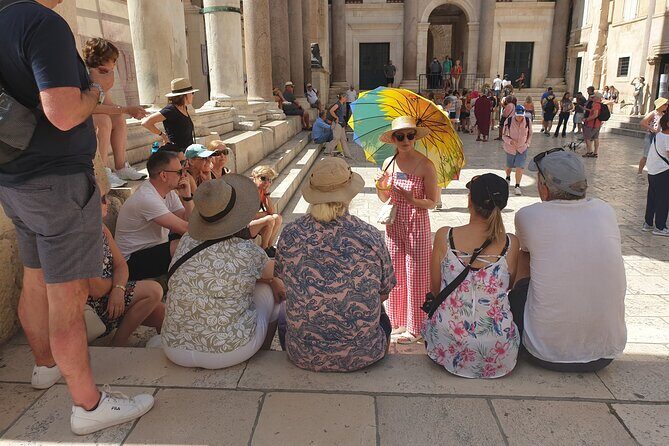
You’ll spend about 15 minutes at the Peristyle of Diocletian’s Palace, which is free to explore during the tour. This is the kind of stop that pays off later when you wander on your own. Once you understand how the square relates to the palace’s other areas, the rest of your self-guided exploring becomes way easier.
Also, this is where you get a first sense of how layered the space is. It isn’t “an old ruin you look at from a distance.” It’s a working historic core where streets and daily life blend into the palace fabric. The guide helps you notice those overlaps instead of just moving past them.
The vestibule (5 minutes): a quick human moment inside the palace story
Next comes the Vestibulum of Diocletian’s Palace. This stop is short, about 5 minutes, and it focuses on the vestibule of Emperor Diocletian. Depending on the day and the guide’s approach, you might also hear something like traditional Dalmatian singing.
Even if the singing bit doesn’t happen, this is still useful because it’s a reminder that imperial spaces were meant to shape movement and mood. A vestibule is not just a hallway. It’s a threshold, and the guide’s explanation helps you see the palace as designed—not accidental.
Substructures walk-through (10 minutes): see the layers without the extra museum time
You’ll then go through the Diocletian Palace Substructures for about 10 minutes. Admission to the museum part of the substructures isn’t included, and the tour does not visit that paid section. Still, even without the museum, this stop helps you understand the palace’s construction and how the substructures functioned over time.
This is one of those “small time, big payoff” parts of the walk. When you look at layered stone underfoot, it’s easy to wonder what you’re actually seeing. The guide’s focus on construction history and shifting uses helps you interpret the spaces instead of treating them like background.
Practical note: if you love the idea of going inside everything, plan to add extra time or an additional ticket later. This tour is designed to give you the foundation so you can decide what’s worth the extra entry.
Golden Gate (10 minutes): Gregory of Nin and why language matters
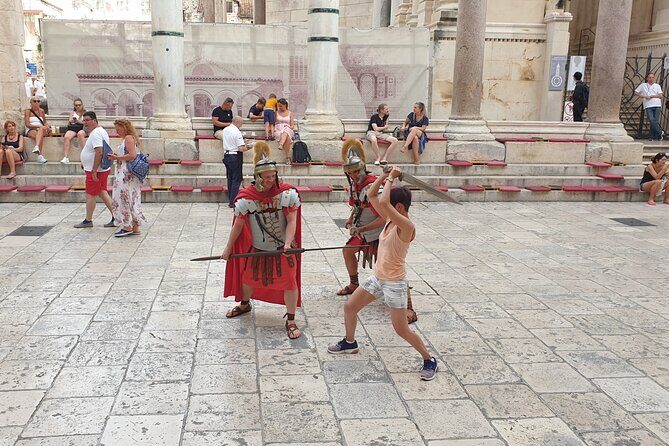
At the Golden Gate, you’ll learn about the main entrance to the palace. You’ll also see the statue of Gregory of Nin, and the guide ties his importance to Croatian history and language. This is where the tour starts to feel more than architectural.
It’s also a good example of how this walk connects “then” and “now.” A gate isn’t just a doorway. It’s a statement about power and identity, and Gregory of Nin becomes the anchor for that meaning. If you like your travel with a little culture and context, this stop delivers.
You’ll have about 10 minutes here, and the stop itself is free. The time is enough to understand what you’re looking at without turning into a long pause in your day.




Riva Harbor (15 minutes): the bronze model and the promenade connection
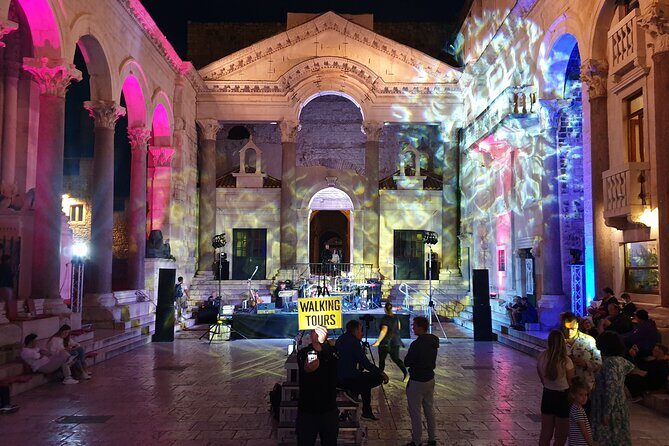
The tour shifts from palace interiors to Riva Harbor, where you’ll see a bronze model of Diocletian’s Palace. This matters more than it sounds. A model is the fastest way to correct your assumptions if your mental picture of the palace is still fuzzy.
From there, you’ll also learn about the history of Split’s Riva promenade. The goal isn’t to recite dates. It’s to show you why the waterfront feels like the spine of the city today, and how the palace ties into what locals do and where visitors end up.
Plan to linger a bit visually here, even if your official stop is 15 minutes. The model plus promenade context is often the moment when the whole place starts clicking.
Fruit’s Square (Trg Brace Radic): a Venetian citadel and Marko Marulić
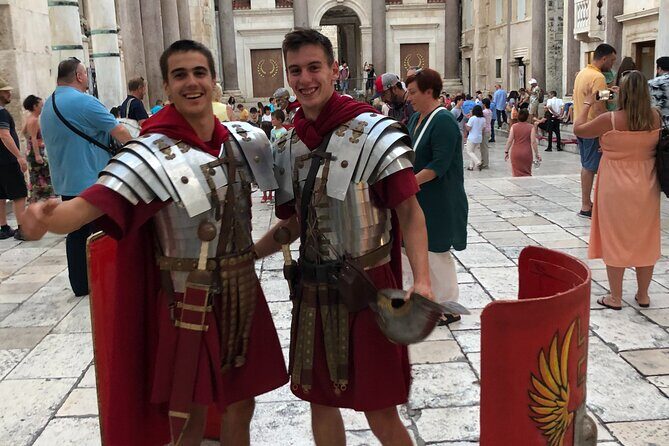
Next you’ll reach Fruit’s Square (Trg Brace Radic), with about 10 minutes for this stop. The tour covers a 15th-century Venetian citadel and introduces Marko Marulić, described as the father of Croatian literature.
This is a nice change of pace after the palace core. Instead of only learning about ancient walls, you also learn about later layers of identity in Split—Venetian influence in the urban fabric, and Croatian cultural pride through literature. If you’re the kind of traveler who likes to understand why a city is the way it is, this stop gives you that “why” in a very digestible format.
Split Synagogue (pass-by): Jewish history with no paid entry included

The walk concludes with a pass-by of the Split Synagogue, a 16th-century site. The tour does not include admission to the synagogue. Still, it’s worth seeing the building from the street because the guide’s explanation about the Jewish people in Split adds meaning to what you might otherwise treat as just another historic facade.
A pass-by works well here because you’re already moving through a lot of major landmarks. If you want deeper access, you can plan a separate visit later when you have time to slow down.
Timing, group size, and how to hear the guide
This tour runs about 1 hour 30 minutes and ends back at the meeting point. Group size maxes out at 20 travelers, which is small enough for a guided conversation if you can position yourself well.
One practical heads-up: multiple guides and groups sometimes overlap in the palace area. I’d plan to be closer to the guide when you can, because headsets or earbuds aren’t provided. If you’re sensitive to sound, this is the one thing to take seriously. Standing too far back can turn even a great explanation into a frustrating blur.
On the good side, the guide talent level is a big part of the experience. Names that come up often include Leo, Mario, Antonio, and Antonella, plus Professor Marino. The common thread is storytelling plus clear explanations, often with a sense of humor.
Price and value: what $48.37 buys you in real sightseeing time
At $48.37 per person for around 90 minutes, this tour is priced like many guided walks in major European historic centers. The value is strongest if you use it for orientation. You’re not just checking boxes. You’re learning how key palace spaces relate to each other, and how Split’s modern streets connect back to that ancient core.
Here’s what helps justify the cost: a guided route that hits multiple major points in a short window, plus free access to several viewing stops like the Peristyle, Vestibulum, and Golden Gate areas. The trade-off is that paid sections aren’t included. The substructures museum part isn’t visited during the tour, and the synagogue has no included admission.
So I’d treat this as the “foundation visit.” If you later decide you want museum time, you can add it. If you mainly want a strong overview and then freedom to wander, this format fits well.
Logistics that matter on the ground in Split
The meeting point is Peristil ulica (Peristil ul.), 21000 Split, Croatia, and the tour ends back there. That means you don’t need to solve the “where do we go next” problem mid-walk, which is a relief in a maze of old streets.
One thing to plan for: the palace area has up-and-down uneven steps, and the tour is not recommended if you have issues with high steps. If stairs are a challenge for you, consider skipping this one or booking it with extra caution.
Also, the start point can be tricky to find in the moment. I’d give yourself buffer time and double-check your map before you arrive. Near public transportation, so you can make it work even if you’re not walking in from far away.
Finally, it’s offered in English, with confirmation received at booking and a mobile ticket. That keeps things simple if you’re hopping between activities during a tight port day or city stay.
Who this tour suits best (and who should skip)
This is best for you if you want a first-day introduction to Split’s palace and historic center without spending hours getting lost. It’s also a good pick if you like structured storytelling, including humor and context that makes the stones feel like they belong to real people and real time.
You might want to look elsewhere if:
- stairs and uneven steps are hard for you
- you’re expecting fully ticketed museum access throughout (the tour doesn’t include admission to the paid parts it mentions)
- you need guaranteed quiet audio, since headsets aren’t included and overlapping groups can affect hearing
Should you book this Split and Diocletian’s Palace walking tour?
I’d book it if you want a smart orientation package in about 90 minutes. The route hits the palace’s key landmarks, then links them to Split’s streets and waterfront, which is exactly what most people need when they arrive the first time.
I wouldn’t book it expecting an all-access museum day. Think of this as the guided foundation, with free major sights and a clear sense of what you’d want to revisit on your own.
If you’re choosing between tour times, pick the one that works best for you and aim to start early enough that you can stand where you’ll hear well. And if stairs are an issue, be honest about it. This walk is worth it when you’re comfortable with the palace terrain.
FAQ
How long is the Split walking tour of Diocletian’s Palace?
It lasts approximately 1 hour 30 minutes.
What does the tour cost?
The price is $48.37 per person.
Is the tour offered in English?
Yes, it is offered in English.
Is admission included?
No admission tickets are included. Some stops are free to view, but paid sections like parts of the substructures museum are not included.
Which main sites are covered?
You’ll see the Peristyle, the Vestibulum, the Diocletian Palace substructures (without the paid museum part), the Golden Gate (with the Gregory of Nin statue), Riva Harbor (with a bronze model), Fruit’s Square (Trg Brace Radic), and you’ll pass by the Split Synagogue (admission not included).
Where does the tour start and end?
It starts at Peristil ulica (Peristil ul.), 21000 Split, Croatia, and ends back at the meeting point.
What group size can I expect?
The tour has a maximum of 20 travelers.
Is the tour accessible if I have trouble with steps?
It is not recommended for travelers who have issues with high steps.
How do I get the ticket?
You’ll receive a mobile ticket, and confirmation is received at booking.
Can I cancel for a full refund?
Yes. You can cancel up to 24 hours in advance for a full refund.