REVIEW · HISTORICAL TOURS
Private History tour – small group
Book on Viator →Operated by Ivan Fistanić · Bookable on Viator
History in Split feels personal on this tour. You get a tight walking route through Diocletian’s Palace that turns stone walls into stories, led by Ivan Fistanić with a Master’s Degree in History. I like that the stop choices are practical—big landmarks first, then the details that explain how the palace and the city changed over time.
The main trade-off is simple: it’s mostly an outside tour. You won’t enter the Cathedral of Saint Domnius, and admission for the Cathedral and the Temple of Jupiter isn’t included—so plan your expectations around seeing and learning from key points rather than going deep inside.
In This Review
- Key highlights that make this Split tour worth your time
- Why this Split private history walk starts at the Golden Gate
- Diocletian’s Palace, explained like a timeline—not a lecture
- Cathedral of Saint Domnius: see the masterpiece without the entry
- Temple of Jupiter: the Roman sky-god space turned baptistery
- Vestibulum and private-chamber entrance: where the “inside world” becomes clear
- Riva Harbor and the palace wall: your payoff viewpoint
- Fruit’s Square (Trg Brace Radic): outside the palace, still dominated by it
- Pjaca: the city’s main square since medieval times
- Grgur Ninski Statue: the landmark with a ritual
- Timing and value: what you’re paying for in this private group tour
- Who this tour suits best (and who might want something else)
- Quick planning notes so your tour goes smoothly
- Should you book this Split private history tour?
- FAQ
- How long is the Private History tour (small group) in Split?
- Where is the meeting point for the tour?
- Is this tour private or shared with other groups?
- How large can the group be?
- Do I need an admission ticket for every stop?
- Does the tour enter the Cathedral of Saint Domnius?
- What’s included in the tour format?
- Where does the tour end?
- Is the tour suitable for most travelers?
- What if the weather is bad?
- Can I cancel for free?
Key highlights that make this Split tour worth your time
- A history guide with a Master’s Degree gives you clear explanations, not just directions.
- Diocletian’s Palace in walking order, from the Golden Gate to the Vestibulum and Peristyle.
- Faith and power, shown side-by-side as Roman spaces became Christian spaces.
- Riva Harbor timing gives you views of the palace wall from the city’s main promenade.
- Central old-town squares (Fruit’s Square and Pjaca) help you connect the palace to daily Split life.
- Grgur Ninski Statue lands with a real local legend and a famous sculptor name (Ivan Meštrović).
Why this Split private history walk starts at the Golden Gate
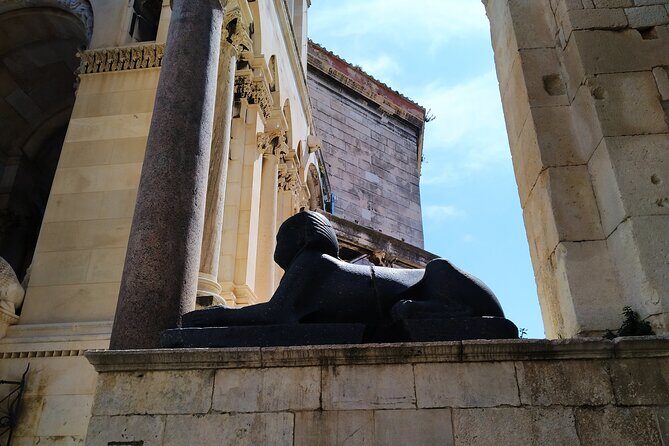
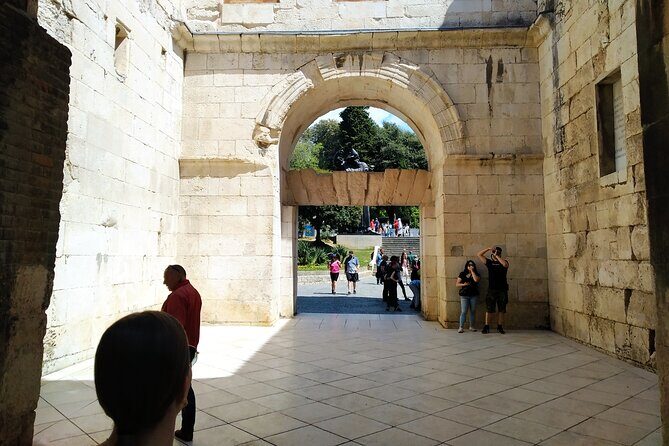
If you want to understand Split fast, begin at the Golden Gate. This gate is the main entrance to Diocletian’s Palace and one of the four main Roman gates. It’s not just a pretty arch—it’s also a directional clue. The road from here heads north toward Salona, once the Roman provincial capital of Dalmatia and Diocletian’s birthplace. That one detail helps you see Split as part of a bigger Roman map, not an isolated old town.
I like that the tour naturally ties the Golden Gate to a recognizable landmark nearby: the Gregory of Nin area. You’ll feel like you’re moving between “anchor points” that people actually use for orientation in the city. That makes the rest of the walk easier, especially if you’re trying to keep your bearings in Split’s maze of stone streets.
Also, the tour flow keeps it efficient. Golden Gate gets time to set the stage, and then you move into the palace core where the real architectural changes tell their story.
You can also read our reviews of more private tours in Split


Diocletian’s Palace, explained like a timeline—not a lecture
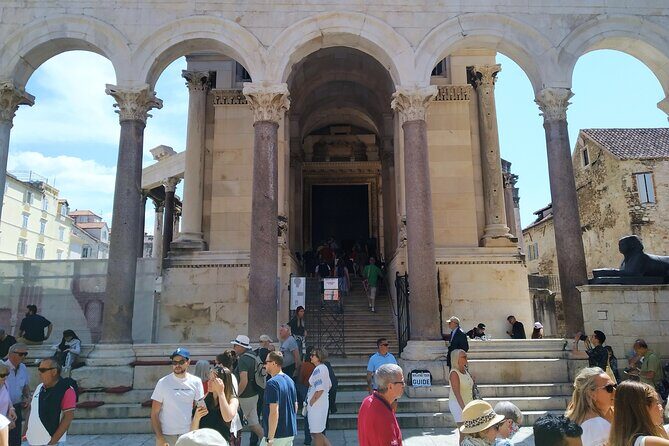
Most Diocletian’s Palace tours skim the “wow” parts and move on. This one is built around how the space worked, and how it changed as history moved forward.
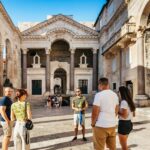
A good example is the Peristyle of Diocletian’s Palace. From the Riva side, you enter the central part of the cellars. You get context on how these underground areas were used over time, then you surface into the Peristyle—the open imperial square framed by monumental arcades. The Peristyle is oriented toward the imperial loggia, which is exactly why it feels designed for authority and ceremony.
And here’s the kind of detail that makes a short private tour feel worth it: you also hear about transitions in the buildings and life as Christianity expanded. You’re not just learning that “things changed.” You’re learning that the same spaces and layouts were repurposed as beliefs and power shifted.
From an experience value standpoint, this is the sweet spot. In about a couple of hours, you get a map of the palace’s layout and a sense of how Roman design links to later religious use. That combination is what turns architecture into understanding.
Cathedral of Saint Domnius: see the masterpiece without the entry
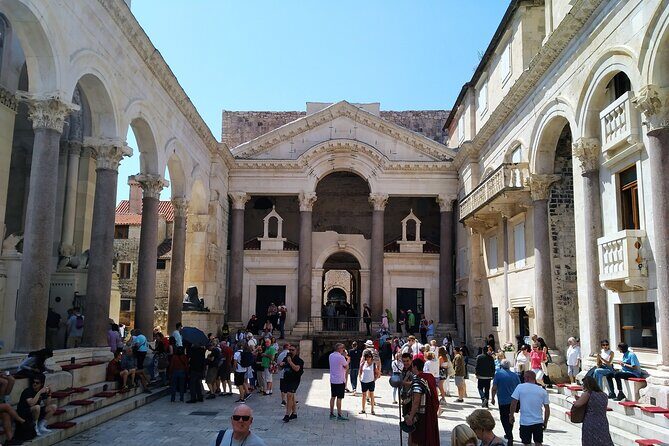
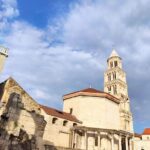
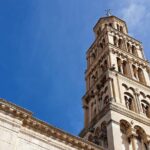
On the Peristyle, Saint Domnius Cathedral is hard to miss. It’s one of the best preserved Roman structures in Split and it’s still in use today. The tour keeps you focused by not sending you inside.
That can be a plus or a minus, depending on what you want. If you’re happy to learn from the best viewpoints and spend time moving to the next stop, you’ll enjoy it. If you were hoping for a full interior look, you may feel a little limited since admission for the cathedral isn’t included and the tour does not go inside.
Even without entry, this stop matters because it anchors the story: a Roman-built structure that didn’t simply vanish. It survived, stayed relevant, and kept living through changing eras. The guide points out significant parts and shares the story behind what you’re seeing, so you don’t just take photos—you understand what makes the building important.
Temple of Jupiter: the Roman sky-god space turned baptistery
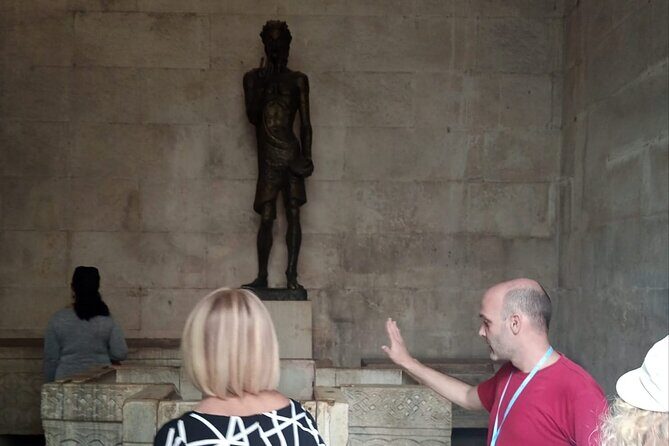
Next up is the Temple of Jupiter, one of the best-preserved late Roman temples in the world. The placement is part of the meaning. The location was chosen to express a divine connection between Emperor Diocletian and Jupiter—the Roman god tied to the sky and thunder, and king of the gods.
Then the tour makes you look at the building again through a different lens: during the Middle Ages, the temple was converted into a baptistery dedicated to St. John the Baptist. That’s a dramatic shift in purpose, and it’s also a very practical historical lesson. You’re seeing how later communities reused powerful Roman architecture instead of starting over from scratch.
Admission for this stop isn’t included, and the tour emphasizes explanation rather than interior access. But as an outside viewing and storytelling stop, it works well. You’re guided to notice the survival and transformation of the structure, which is often what matters most in places like this where time is tight and streets are crowded.
Vestibulum and private-chamber entrance: where the “inside world” becomes clear
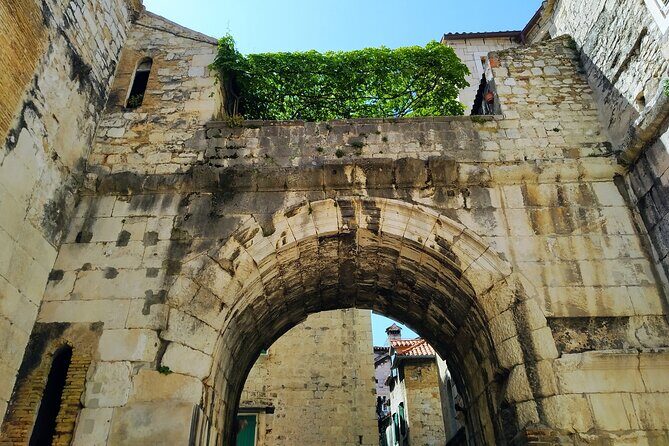
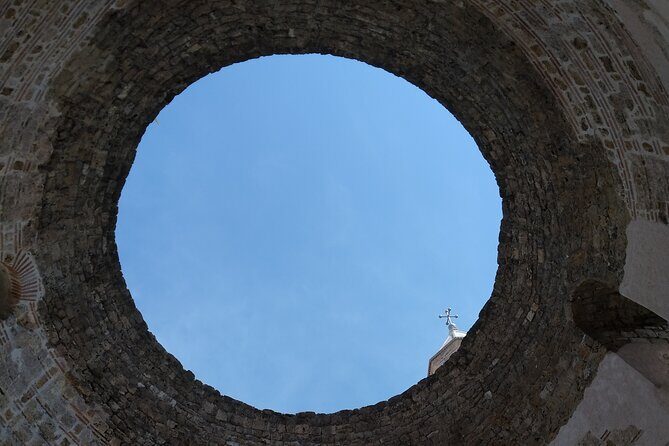
The Vestibulum of Diocletian’s Palace is easy to overlook if you just walk past it. That’s why it’s a smart inclusion. This vestibule served as the pre-entrance to Diocletian’s private chambers, and it was decorated based on its importance.
What I like about this stop is that it turns scale into intimacy. You’re still in a monumental palace complex, but the guide is pointing you toward how access and movement worked—how someone would transition from public spaces into more private ones. You’ll also “check up” the triclinium, the dining room area linked to how the elite lived and hosted.
This is where a local guide trained in history really helps. Small details become understandable when someone explains function and purpose, not just dates. And because this is a walking tour, those explanations land quickly before you move on.
You can also read our reviews of more historical tours in Split

Riva Harbor and the palace wall: your payoff viewpoint
After palace-focused stops, the tour shifts back to the city with Riva Harbor. This is where locals and visitors meet, and it’s the main promenade. It also acts like a reset button for your brain: you step out of the palace “inside story” and back into the place where Split actually breathes.
The guide explains how Riva was built over the centuries and why it became such a central place for locals. Then you get a key visual: the southern wall of Diocletian’s Palace viewed from this side.
That’s an important practical takeaway. Many people see the palace from one angle and think it’s just a ruin. Standing where Riva sits, you start understanding the palace as something physically integrated into the waterfront—built to watch the city develop and to anchor it.
If you want photos that show both “old Split” and “lived-in Split,” this is one of the best windows on the route.
Fruit’s Square (Trg Brace Radic): outside the palace, still dominated by it
Next is Fruit’s Square (Trg Brace Radic), described as one of the most picturesque squares just outside the palace. The tour keeps it specific: there’s a monument in the middle, and you’ll hear about the key sights around the square.
What makes this stop interesting is the sense of layered time. The square is dominated by the remains of a 15th-century Venetian fort, which tells you that Split didn’t just become “Roman and finished.” After Diocletian’s era, later powers left marks here too.
This is the stop that helps you connect the palace to the street level. You’re moving from imperial architecture to the everyday geography where commerce and community would have happened. Even if you’re not stopping for a snack, you’ll feel how the palace shaped surrounding space.
Pjaca: the city’s main square since medieval times
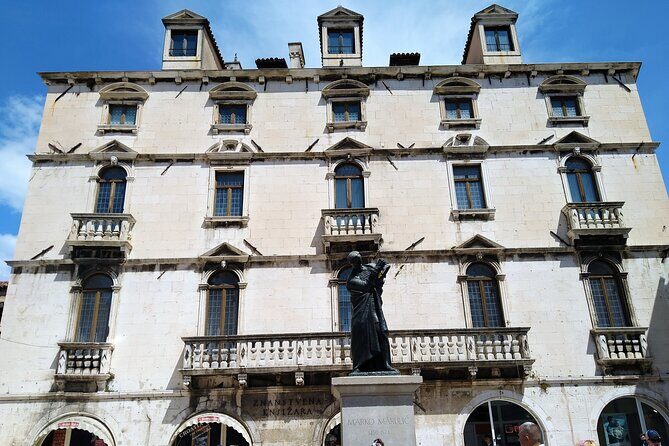
From Fruit’s Square, you move to Pjaca, in front of the old Town Hall area and outside the western wall of the palace. The guide frames it as the main square of the city since medieval times.
You’ll see the 14th-century Town Hall and other interesting structures around the square. This is a great place to pause mentally. By now you’ve seen gates, temples, and palace functions. Pjaca gives you the civics view—how a city organizes itself around a central gathering space.
If you’re worried about the tour feeling too “archaeology-only,” this stop helps balance it. It keeps the narrative anchored to what people still use: a real square, a real hub.
Grgur Ninski Statue: the landmark with a ritual
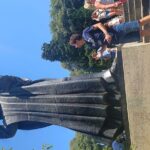
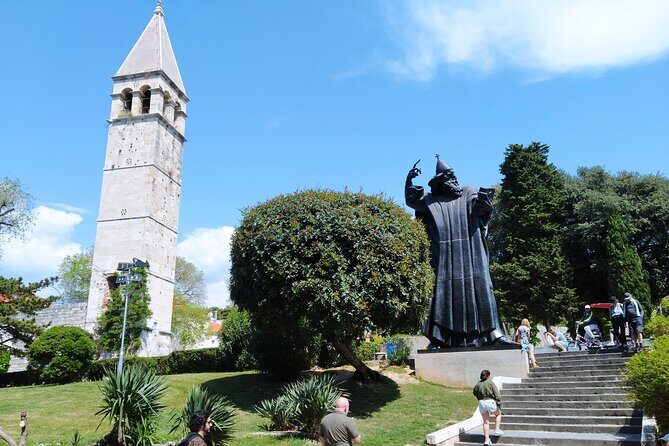
Finally, the Grgur Ninski Statue lands as a recognizable Split landmark. The guide shares the story behind Gregory of Nin, including that the monument dedicated to him is among the highest in Split. You’ll also learn about the sculptor: Ivan Meštrović.
Then there’s the famous local ritual: rub its toe for good luck. It’s a simple act, but it matters because it connects all the history you’ve been hearing to a living tradition people still repeat.
This ending choice is smart. After the palace’s heavy historical layers, you finish with something more human and playful—while still tied to the city’s past.
Timing and value: what you’re paying for in this private group tour
This is priced at $238.28 per group for up to 10 people, lasting about 1 hour 30 minutes to 2 hours. That pricing structure is worth understanding before you book, because it affects value more than the headline number.
For small groups, the per-person cost can drop quickly. You’re also not paying for bus tours with a crowd. You’re paying for a private history guide who can keep a clear pace and answer questions. And because it’s a mobile ticket tour, you avoid hassle at check-in.
Another value point: several stops are marked as admission ticket free, including the Golden Gate, Peristyle, Vestibulum, Riva Harbor, Fruit’s Square, Pjaca, and the Gregory of Nin statue area. The Cathedral of Saint Domnius and the Temple of Jupiter list admission as not included, though the tour does not enter the cathedral. So you’re mainly paying for the guidance and the storytelling coverage across major sights, not for entrances to multiple buildings.
The time is also realistic. You get a meaningful overview of Split’s most important palace-related sites and key squares without burning your whole afternoon.
Who this tour suits best (and who might want something else)
This private history walk is a strong fit if you want:
- A guided overview of Diocletian’s Palace and the city’s connected landmarks
- A small group pace with a guide who can handle questions
- A route that mixes Roman architecture with Christian-era changes and later Venetian influence
It may be less ideal if you’re specifically craving lots of interior time inside major buildings. Since the cathedral isn’t entered and admission isn’t included for some stops, your best experience comes from being happy with outside views plus deep explanations.
It’s also a good match for first-timers who want to orient themselves quickly and for history lovers who enjoy how one era repurposes another.
Quick planning notes so your tour goes smoothly
- Meet at Ul. kralja Tomislava 15, 21000 Split. It’s central, so you can usually work it into your day without chaos.
- It’s a private tour for your group only, up to 10 people, so you won’t be squeezed into a large crowd.
- Plan around the fact that the experience requires good weather. If weather is poor, you’ll be offered a different date or a full refund.
- Bring a charged phone for the mobile ticket.
- Wear footwear you’re comfortable walking in. You’ll be moving along old-town stone and uneven palace-adjacent areas.
Should you book this Split private history tour?
Book it if you want a smart, time-efficient way to understand Split’s most important architecture and how it evolved. The big win is the way the route connects the Golden Gate, the Peristyle, and the major “conversion points” like the Temple of Jupiter and the Christian-era presence around Saint Domnius. Add in the city anchors—Riva, Fruit’s Square, and Pjaca—and you leave with a clear mental map of how the palace shaped the whole town.
Skip it only if you’re looking for a tour focused on multiple interior museum-style visits. This one is built for outside seeing plus expert explanation, and it rewards curiosity about how the stones got their current meanings.
FAQ
How long is the Private History tour (small group) in Split?
It runs about 1 hour 30 minutes to 2 hours.
Where is the meeting point for the tour?
The start meeting point is Ul. kralja Tomislava 15, 21000 Split, Croatia.
Is this tour private or shared with other groups?
It’s private. Only your group participates.
How large can the group be?
Up to 10 people per group.
Do I need an admission ticket for every stop?
No. Some stops are free, while admission ticket access for the Cathedral of Saint Domnius and the Temple of Jupiter is not included.
Does the tour enter the Cathedral of Saint Domnius?
No. You won’t be entering inside, but the guide will explain what you need to know.
What’s included in the tour format?
You get an introduction walking tour of Split’s main sights with a local guide who has a Master’s Degree in History, plus a mobile ticket.
Where does the tour end?
It ends back at the meeting point.
Is the tour suitable for most travelers?
Most travelers can participate.
What if the weather is bad?
The experience requires good weather. If it’s canceled due to poor weather, you’ll be offered a different date or a full refund.
Can I cancel for free?
Yes, free cancellation is available. You can cancel up to 24 hours in advance for a full refund.