REVIEW · DIOCLETIAN'S PALACE
Split Diocletian Palace Highlights – Private walking tour
Book on Viator →Operated by Split Guide · Bookable on Viator
Roman Split clicks fast.
This private walk through the Diocletian’s Palace complex gives you quick clarity on how the whole Old Town is laid out, not just random ruins. I love that it stays practical and story-driven, so you can connect gates, chambers, and streets into one picture.
You’ll also like the way the route links ancient spaces to everyday life, with stops along the Split Riva and through the market zone. That mix matters because Diocletian’s Palace is still lived in, full of shops and homes, so the sights feel less like a lesson and more like real place-watching.
One consideration: it’s an outside-view tour only, so you won’t step inside the cathedral or temple spaces. If you want indoor artifacts or museum-style exhibits, you’ll likely need a separate add-on.
In This Review
- Key highlights worth showing up for
- Getting oriented in Old Town Split in just 90 minutes
- The walk starts with the Riva, where Split shows itself
- Diocletian’s Palace: Rome built it, and Split kept using it
- South gate cellars: seeing the palace’s real size
- Peristyle: where the emperor showed himself
- Saint Domnius outside view: Roman mausoleum to Christian cathedral
- Iron Gate and the market: ancient boundaries, modern shopping
- Triclinium dining room: how an emperor ate
- Vestibulum and Temple of Jupiter: private vs public power
- West and north gates: military design to Roman routing
- Green Market and finishing back on the Riva
- Price and value: what $137.80 buys you here
- Practical tips so the walk feels easy
- Should you book this Diocletian Palace highlights tour?
- FAQ
- How long is the Split Diocletian Palace highlights private walking tour?
- Is the tour private?
- How many people are in the group?
- What language is the tour offered in?
- Where do you start and end?
- Are entrance fees included?
- Does the tour include entry into the cathedral or temple?
- What kind of ticket do I receive?
- Can I get a refund if plans change?
- What if the weather is bad?
Key highlights worth showing up for
- A small-group private format (designed for up to 6 participants, with a max group size set higher) makes questions easy
- Diocletian’s Palace, explained as a living neighborhood, not a sealed museum
- Cellars + Peristyle framing so you understand scale and Roman power before you get lost in streets
- Gate-to-market routing, with the Iron Gate area connected to real shopping and local food
- A single, efficient loop that brings you back to the Riva for an easy finish
Getting oriented in Old Town Split in just 90 minutes
This tour is built for the moment you first arrive and Old Town starts to blur. Split’s palace walls stretch across the center, and streets fold into each other quickly. A guide helps you build a mental map fast, so later, when you wander on your own, you’re not just walking between postcards.
The time window is about 1.5 hours, which is exactly long enough to get your bearings. It’s also calm enough that you can still explore afterward at your own pace, rather than feeling like you used up your whole day on guided walking.
Price can look steep at first glance, especially for an outside-only experience. But you’re paying for the storytelling and route design: someone does the hard part of connecting the dots between Roman engineering, Christian reuse, and today’s street life.
You can also read our reviews of more walking tours in Split
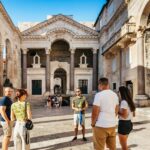
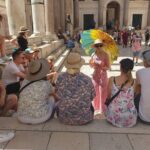

The walk starts with the Riva, where Split shows itself
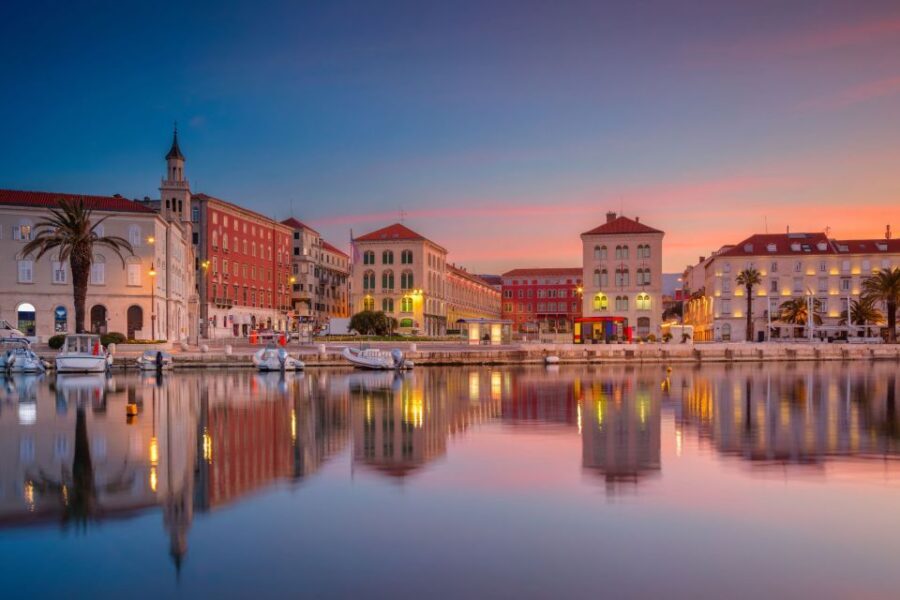
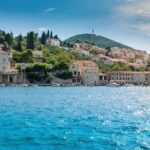
You begin at the Model of the historical core of the city of Split, then you move out onto the Split Riva promenade. This is one of those places where locals and visitors overlap, and you get an instant feel for the city’s rhythm. People sit with coffee. Families stroll. You’ll see the kind of casual energy that makes Split feel like a holiday, not a museum.
This stop also has a practical job. It sets your orientation for the rest of the route. Once you’ve seen where the promenade runs, the palace walls and gates feel less mysterious.
A small tip: if you’re visiting on a bright day, keep an eye on shade. The early portions near the waterfront can be warm, and you’ll want that energy later when the route moves through tighter stone spaces.
Diocletian’s Palace: Rome built it, and Split kept using it
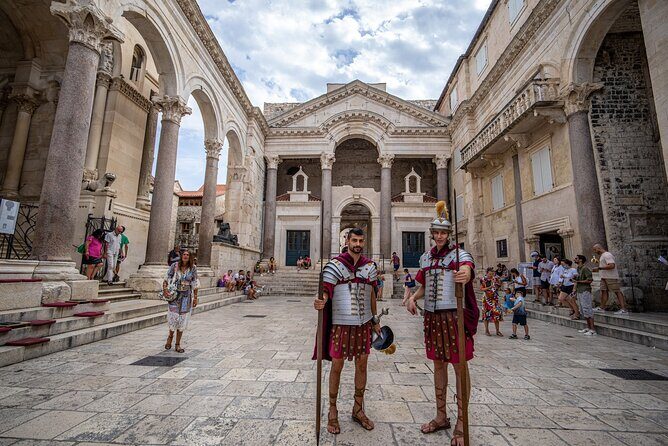
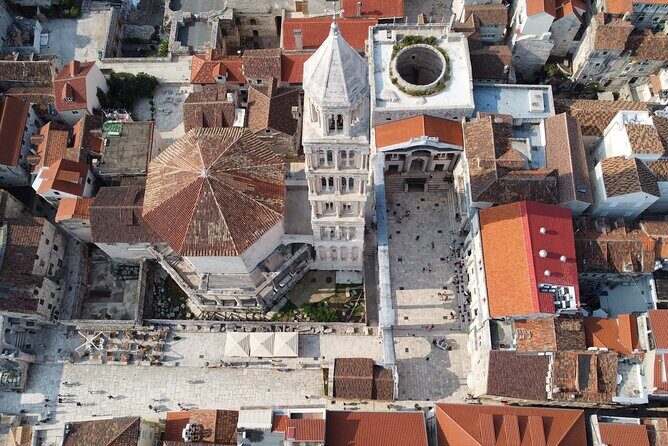
The main event is Diocletian’s Palace itself—built and inhabited by Emperor Diocletian over 1700 years ago. The key thing to understand is that it isn’t a classical museum. It’s a functioning neighborhood inside ancient walls. There are houses, shops, and daily bustle right where you expect ruins to be quiet.
That changes how you should watch it. Instead of only looking for dramatic fragments, you’ll start noticing structure: street alignments, doorways, and how modern life fits into Roman planning. It feels like the city is layered, not frozen in time.
At this stop, I’d pay attention to the contrast between scale and intimacy. Some parts of the palace feel huge, while your viewpoint stays close to everyday storefronts. That mix is part of why Split is so easy to love once you understand what you’re seeing.
South gate cellars: seeing the palace’s real size
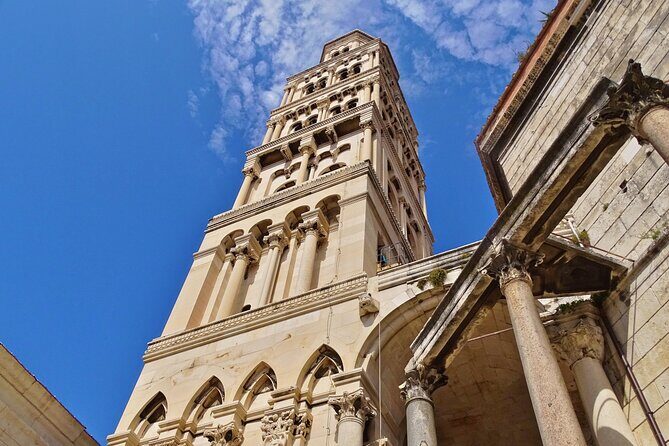
Next you head through the south gate into Diocletian’s Cellars. These are also built more than 1700 years ago and are very well preserved, which makes them a powerful scale reference. It’s one thing to view an exterior wall, but stepping into the cellar spaces (still viewed as part of the walk) helps you grasp how much space the palace originally held.
The cellars do two things for you as a visitor. First, they prove this wasn’t a small retreat. Second, they set the tone for the rest of the tour—stone that’s still standing for practical reasons, not just dramatic reasons.
If you’re thinking about taking photos, this is a good moment to slow down. The lighting and stone textures can be more interesting down here than in the open courtyards above, depending on the time of day.
Peristyle: where the emperor showed himself
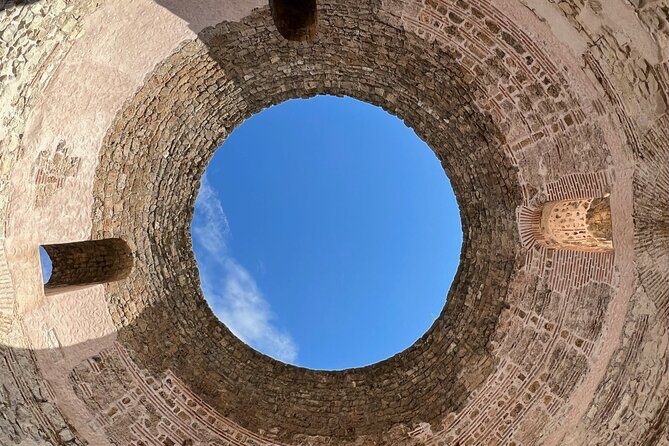
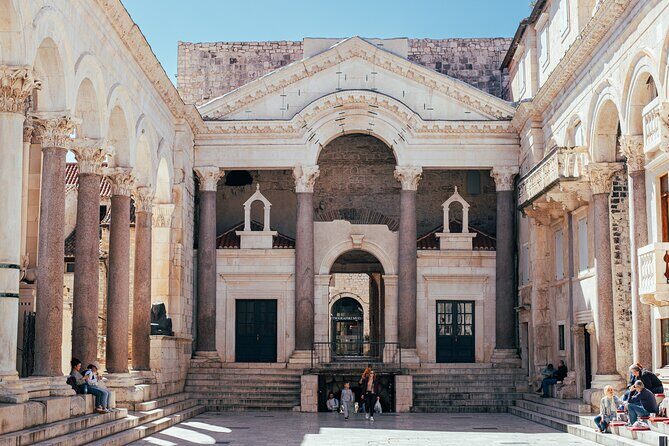
Then comes the Peristyle of Diocletian’s Palace, the sacral meeting place in Diocletian’s time. This is where the emperor presented himself to subjects and reinforced his role as more than a ruler. The tour frames it as worship linked to Jupiter, which helps the space make sense rather than just looking like another big courtyard.
It’s also a reminder of how power worked in Roman cities. Public areas weren’t neutral. They were stages. You don’t need to know every Latin term to feel the logic of the layout once you’ve heard the context.
A quick mindset shift helps here: don’t just look for what’s left. Look for what would have been the focal point when it was active. Once you do that, the Peristyle stops being a stop on a list and starts feeling like a center of gravity.
You can also read our reviews of more private tours in Split




Saint Domnius outside view: Roman mausoleum to Christian cathedral
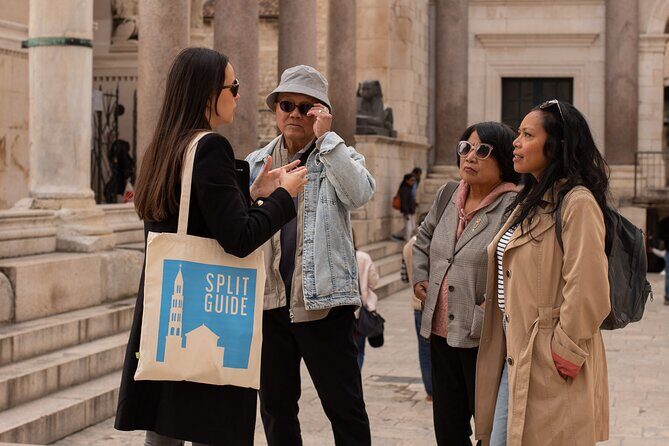
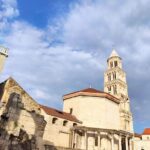
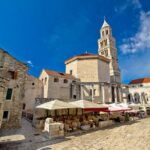
From the Peristyle, you reach the Cathedral of Saint Domnius area. This cathedral was once the mausoleum of the late Emperor Diocletian. Later, as the city Christianized, the coffin and mortal remains disappeared, and the pagan mausoleum became a Christian cathedral.
Your tour looks at the cathedral from the outside, with no entrance fee included. That limitation might sound like a downside, but it’s actually useful for most first-timers. You get the big story in minutes, then you can decide later if you want to come back for an interior visit.
As you look at it, try to spot the layers in your head: Roman tomb logic turning into Christian worship logic. Even without going inside, that transition gives you a strong theme for the whole day.
Iron Gate and the market: ancient boundaries, modern shopping
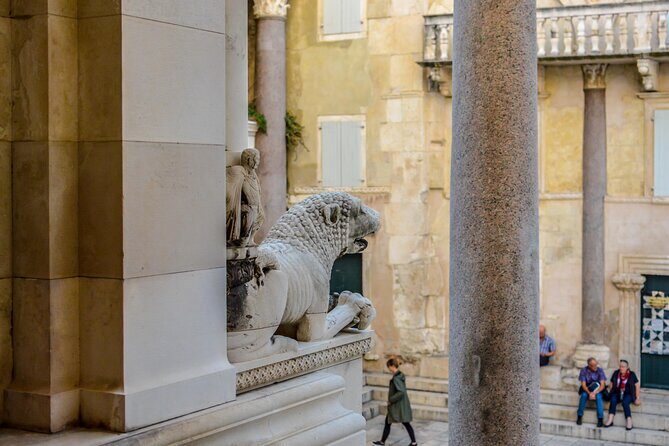
One of the most practical parts of the route happens around the gates. You’ll see the Iron Gate, described as a gate that was walled up several times and reopened in the 1940s. Today, it leads you toward the market area where locals sell products.
This stop is worth it because it breaks the habit of treating ancient sites like lifeless scenery. Here, the palace’s edges are also street-level commerce. It’s the same idea you felt inside the palace walls: history didn’t vanish. It changed jobs.
If you like food and simple local finds, keep your eyes open for what’s seasonal. The market zone is where you’ll get real texture about what everyday life looks like in Split.
Triclinium dining room: how an emperor ate
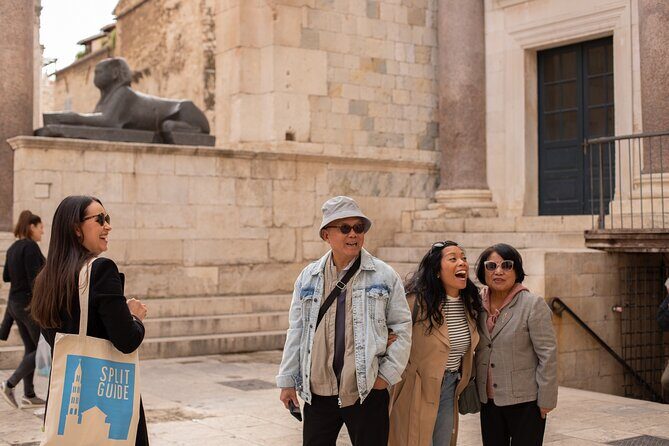
Next is Triklinij, the triclinium, which means dining room. This is where Diocletian dined with guests, and the tour ties the space to Mediterranean food habits. The details you’re given here make the room feel specific: wine and fish, and honey as a notable favorite. It also notes that evenings could feature up to 20 different courses.
This is where I find the tour particularly smart for non-specialists. You don’t need to be a Roman food scholar. When you hear about the kind of meals an emperor had, you start to understand the social purpose of the space. It’s not just architecture. It’s a system for hospitality, status, and ritual.
Photo note: dining rooms are interior by nature, but your outside-view approach means you’ll be studying the shape and placement rather than trying to recreate the table. Focus on how the layout connects back to the rest of the palace.
Vestibulum and Temple of Jupiter: private vs public power
You also pass the Vestibulum of Diocletian’s Palace, described as the entrance area to Diocletian’s private chambers. That detail matters. Roman palace planning often creates a transition from public spaces to controlled, private access. You get a sense of how movement would have felt—public exposure shifting toward restricted areas.
After that, you look at the Temple of Jupiter, which is now a baptistery. Like the other key cathedral-related stop, you’re viewing it from outside. Still, the tour’s framing helps you understand reuse over time: pagan sacred space turning into Christian ritual space.
If you’re the type who likes to connect eras, this pair of stops gives you a clear contrast. Private chambers and sacred conversion stories are both about control—who gets access, and what meaning a space carries when religion changes.
West and north gates: military design to Roman routing
The route then goes through two more gate highlights: the west Iron Gate area and the Golden Gate.
The west gate is described as a double gate, called Propugnaculum, and the area between the two gates could trap enemies so they’d be hit with stones, arrows, and hot oil. Whether you’re picturing siege tactics or just the defensive logic, the point lands: these weren’t decorative entrances. They were tools.
Next comes the Golden Gate, the north gate of Roman times, and it was the most important. From here, the road led to the city of Salona, capital of the Roman province. This helps you see the palace not as an isolated fortress, but as a connected node in a bigger network of roads and administration.
That kind of context is the difference between staring at stone and understanding why those stones were placed there.
Green Market and finishing back on the Riva
On the east side of the palace, you reach the Green Market, with fresh fruits, vegetables, and other traditional foods sold daily. Even if you don’t buy anything, it’s a strong stop because you’re now standing in a place that matches what the palace edges have been doing for centuries: serving the needs of the living city.
Finally, you loop back along the palace walls to the Split Riva promenade. This ending is practical. It gives you a clean finish point at Republic Square and a chance to relax before you continue exploring. It also reinforces what you started with: Split’s pleasure is in how history and everyday life share the same streets.
If you’re planning your evening, this is a good moment to decide on dinner nearby. The route puts you close to the core where cafes and restaurants cluster.
Price and value: what $137.80 buys you here
At $137.80 per person for about 90 minutes, this isn’t a budget stroll. But it is priced like a guided private experience, and you do get clear value because the tour is designed around high-impact orientation.
Here’s the value equation as I’d see it:
- You avoid entrance fees for what you’re seeing, since the sights are viewed from outside.
- You get a guided route through a complex site where self-guided wandering can turn into guesswork.
- Small group size means you can ask questions without losing the flow.
- Time efficiency matters. Old Town Split is compact but confusing, and 90 minutes can prevent wasted hours.
The only part that might feel like a mismatch is if your dream day is mostly indoor museum time. This tour focuses on the outside view: gates, courtyards, and major landmarks with story context.
One more practical detail: the tour is often booked about 22 days in advance on average. If your dates are fixed, I’d treat it as something to reserve early rather than gamble on walk-up availability.
Practical tips so the walk feels easy
This experience uses a mobile ticket, runs in English, and can be customized. The provider notes it can be adapted to special needs if you inform them in advance, and service animals are allowed.
Weather matters. It requires good weather, and if it gets canceled due to poor conditions, you’ll be offered a different date or a full refund. That’s important in Split, where the sun can be great but sudden rain can ruin stone-day plans.
What you should bring:
- Comfortable walking shoes with grip
- Water, especially in warmer months
- Sun protection if your day starts at the Riva and continues under open skies
Also, the meeting point is at the Model of the historical core of the city of Split, and the tour ends at Republic Square in the Prokurative area. That makes it easy to link the tour to a later walk or meal without backtracking.
Should you book this Diocletian Palace highlights tour?
Book it if you want a fast, clear first pass through Diocletian’s Palace with strong storytelling and minimal friction. It’s especially good if you like your history connected to real places—shops, markets, and streets that still feel alive.
I’d skip it (or plan other add-ons) if your priority is indoor entry and museum-style exhibits. Since everything is outside-only, you won’t get inside access here.
One final nudge: if you enjoy guided interpretation, look for the guide who has a reputation for standout narration. In this case, the name Dana comes up as an exceptional guide who makes the Roman-to-Christian story feel human, not academic.
FAQ
How long is the Split Diocletian Palace highlights private walking tour?
The tour lasts about 1 hour 30 minutes.
Is the tour private?
It’s a private walking tour experience designed around small groups.
How many people are in the group?
The tour is designed for a group maximum of 6 participants, and it also notes a maximum of 10 travelers.
What language is the tour offered in?
The tour is offered in English.
Where do you start and end?
Start: Model of the historical core of the city of Split, Obala Hrvatskog narodnog preporoda 23, Split. End: Republic Square, Prokurative, Split.
Are entrance fees included?
Admission tickets are free for the sights the tour focuses on, and the sights are visited only from the outside.
Does the tour include entry into the cathedral or temple?
No. The cathedral is looked at from the outside, and the temple is also viewed from the outside, with no entrance fee included in the tour.
What kind of ticket do I receive?
You receive a mobile ticket.
Can I get a refund if plans change?
Free cancellation is available up to 24 hours in advance for a full refund.
What if the weather is bad?
The tour requires good weather. If it’s canceled due to poor weather, you’ll be offered a different date or a full refund.