REVIEW · WALKING TOURS
Private Split Walking Tour with Cathedral Entrance
Book on Viator →Operated by Tourdesksplit · Bookable on Viator
Split’s palace ruins feel personal.
This private walking tour uses live narration to move you through UNESCO Split, from Riva Harbor to the heart of Diocletian’s Palace and the Cathedral area. I especially like the way the guide builds a clear story as you walk—so you’re not just looking at stone. I also love the convenience of having admission fees included, with a Cathedral of Saint Domnius entrance built into the tour.
The big heads-up: the bell tower isn’t part of the guided portion because it’s listed as closed for renovation. If bell-tower photos are your goal, plan for other viewpoints around the old town.
In This Review
- Key highlights you’ll notice fast
- Why Diocletian’s Palace in Split is hard to do alone
- Meeting at the Model of the Palace: how the tour starts
- Riva Harbor to the palace substructures: orientation with a story
- Peristyle and the palace courtyard logic
- Saint Domnius Cathedral entrance: what you get and what’s missing
- Jupiter’s Temple pass-by: quick sight, big context
- Gates and museum exterior: how to read Split’s city walls
- Narodni Trg and Zeljezna Vrata: the old town’s rhythm
- Why Fruit’s Square shows up twice
- Palazzo di Diocleziano again: tying the big picture together
- Private pacing and that one-person attention advantage
- Ticket convenience: what included admissions really means for you
- The little extras that make it feel human
- Weather, fitness, and the bell tower reality check
- Who should book this private Split cathedral and palace walk
- Should you book this Private Split Walking Tour with Cathedral Entrance?
- FAQ
- How long is the private Split walking tour?
- What’s included with the Cathedral of Saint Domnius?
- Are admission tickets included in the price?
- Can the itinerary be customized?
- Is this tour really private?
- What if the weather is bad or I need to cancel?
Key highlights you’ll notice fast
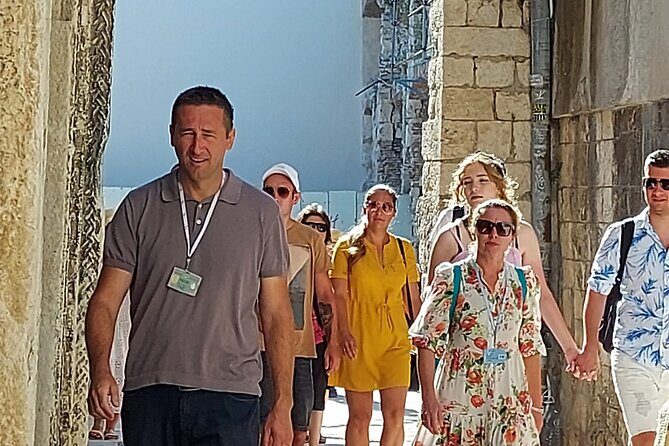
- Certified local guide with live narration that keeps the walking from feeling like a checklist
- Cathedral of Saint Domnius entry included (with the Diocletian’s Mausoleum setting)
- Private tour flexibility, so you can steer questions and pacing to your interests
- Diocletian’s Palace substructures through the Peristyle, not just the obvious courtyard
- Old town gates and squares loop: Silver Gate, Golden Gate, Trg Brace Radic, and Narodni Trg
- Bell tower not included due to renovation closure
Why Diocletian’s Palace in Split is hard to do alone
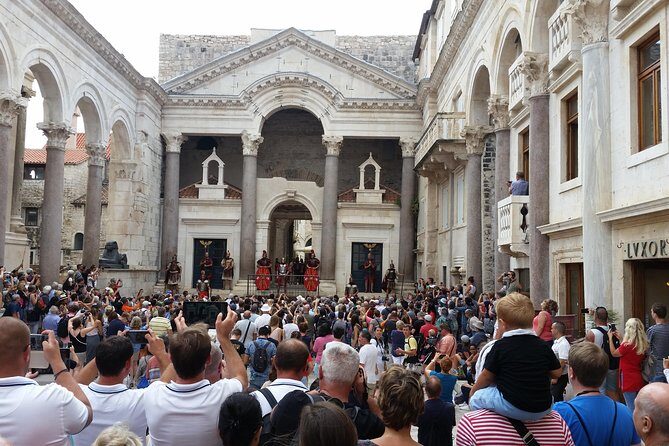
Diocletian’s Palace is the reason Split exists in the way you recognize today. It’s one part Roman monument, one part medieval town, one part modern daily life. Without a guide, it’s still beautiful—but it’s easy to feel lost in the scale and timing. You’ll see walls and arches, sure. But the real payoff is understanding what you’re looking at and why it was built that way.
On this private tour, you get a local to connect the dots while you walk. In the reviews, the name Filip comes up again and again for being personable and able to explain history in a way that actually sticks. That matters in Split, because the palace isn’t a single building. It’s a whole system: entries, corridors, courtyards, and sacred spaces packed into a compact footprint.
You can also read our reviews of more walking tours in Split

Meeting at the Model of the Palace: how the tour starts

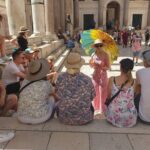
You start at the Model of Palace on Obala Lazareta 1. That’s not just a random meeting spot. It gives you a quick mental map before you step into the real thing. I like tours that start with orientation, because Split’s old streets can feel like a maze if you haven’t anchored where you are.
From there, you’ll move into the palace complex and surrounding old town. The whole experience runs about two hours and stays on foot. The tour is described as family friendly, which usually means the route is manageable and not an all-day slog. Still, you should have moderate physical fitness, since it’s walking through uneven historic stone.
Riva Harbor to the palace substructures: orientation with a story
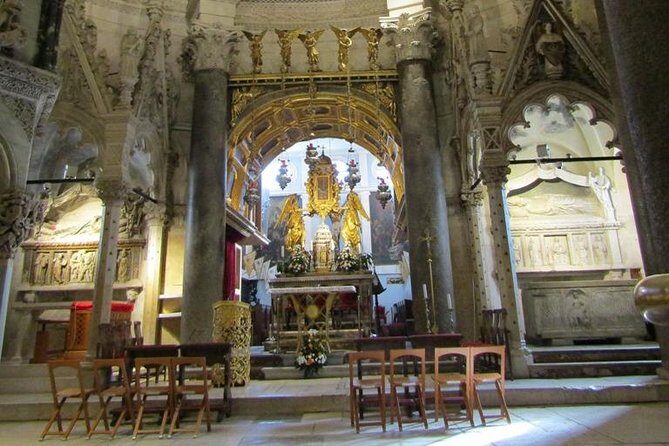
Your first stop is Riva Harbor. It’s your easy “hello” to Split: water views, lively harbor energy, and a sense of how the city faces the Adriatic. This matters because Diocletian’s Palace is not floating in a vacuum. It was part of a real place where movement and trade mattered.
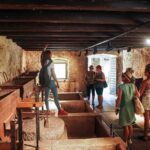
Then the route turns into the palace: first the central part of the substructures of Diocletian’s Palace. This is a smart choice. Many palace tours focus only on the most photogenic bits. Substructures are where you start to understand how the Romans handled space—what was above ground, what supported it, and what created layered movement. Even with only about ten minutes here, it sets the tone for everything after.
Next you hit the Vestibulum (just five minutes). Think of this as a transition space—an in-between zone that helps you “feel” the palace layout. When a guide points out how these entry-and-transition areas worked, your eyes stop glazing over at arches and corridors.
Peristyle and the palace courtyard logic
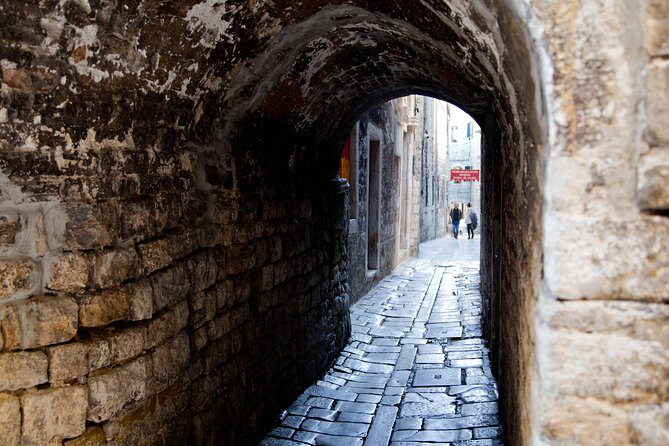
The Peristyle of Diocletian’s Palace is next, with a guided visit for about ten minutes. This is the courtyard where the palace starts to look like the grand center it was meant to be. Columns, openings, and sightlines all do their jobs here.
In a good tour, you don’t just stand and look—you learn the purpose of the place. You’ll get context for how a space like this functioned day-to-day, not only as a symbol. That’s where a strong guide earns their fee: explaining how power, movement, and design connect.
Then you continue deeper into the historic core, with the pace staying “walk, see, understand” instead of “walk, follow, hope.”
Saint Domnius Cathedral entrance: what you get and what’s missing
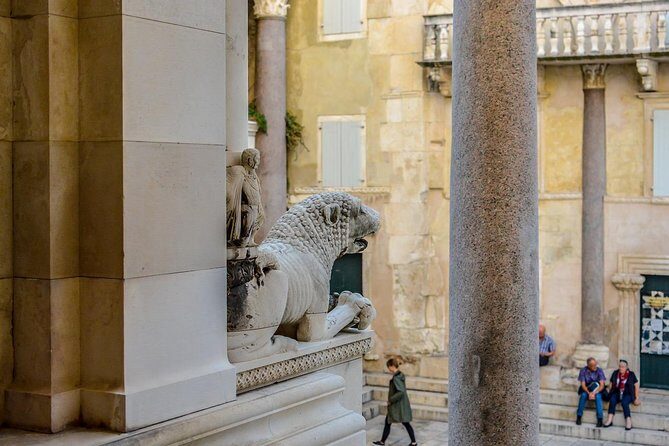
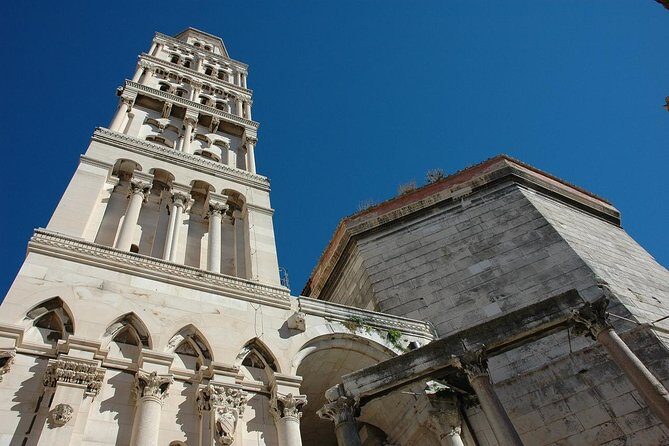
The Cathedral of Saint Domnius is the tour’s big ticket moment—about twenty minutes, with the inside visit included. This cathedral sits in the setting of Diocletian’s Mausoleum, and that gives it a particular charge. You’re not just touring a church; you’re in a space that carries the weight of transformation over centuries.
The guide will do a guided visit of the cathedral area. That’s key, because cathedrals can become “pretty but general” if you’re on your own. With narration, you’ll understand what makes this church linked to the palace story—why the site matters, and how the sacred space fits into the broader Roman-to-Christian evolution of Split.
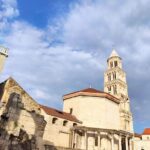
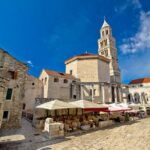
Heads-up on the bell tower: the listing notes there is no guided visit of the Bell Tower because it will be closed until 2022 for renovation. If you were hoping for a climb or a dedicated explanation of the tower, you’ll want to treat the bell tower as off-limits for this tour.
You can also read our reviews of more private tours in Split




Jupiter’s Temple pass-by: quick sight, big context

Between the cathedral and the gates, the route includes a pass by an ancient Jupiter’s Temple. It’s not framed as a long stop, which means you shouldn’t expect a full deep-lecture moment here. Still, it’s a valuable connection point.
Why? Because it reminds you that the palace wasn’t just domestic or administrative. It also held religious meaning in the Roman world. A good guide will use this as a checkpoint to show how different belief systems and political shifts left physical traces.
Even a quick pass-by can be useful if you know what to look for. It’s the difference between seeing ruins and recognizing what those ruins represent.
Gates and museum exterior: how to read Split’s city walls
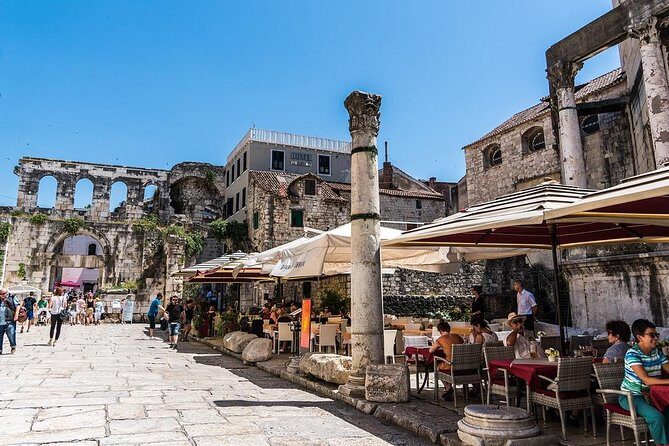
Next you’ll move through Eastern (Silver) Gate (about five minutes). City gates sound simple until you learn how they worked as controlled entry points. In a palace city like Split, gates weren’t just for traffic. They were part of the palace’s sense of order.
After that, you get an outside view of the City Museum of Split for about five minutes. Outside-only is important to know. You won’t have a museum interior visit here based on the tour outline. Still, this stop works as a way to keep you oriented in modern Split while staying anchored in the UNESCO setting.
Then comes a sequence of squares and gates that makes Split feel like a living city, not a theme park. Fruit’s Square (Trg Brace Radic) (five minutes) is one of the classic names you’ll hear around town, and the guide’s job is to connect it to palace-era rhythms and later city life. You’ll also pass the Golden Gate (five minutes), another palace entry point. Seeing it with context helps you notice details you might otherwise miss.
Narodni Trg and Zeljezna Vrata: the old town’s rhythm
Narodni Trg is a guided visit for about ten minutes. This is where Split’s old town starts to feel more like the modern city core. Squares are social centers, and walking them with a guide helps you understand their role over time—why people gathered here, how movement routes shaped daily life, and how buildings used space.
Then the route includes Zeljezna Vrata (five minutes). Iron Gates sounds dramatic, but the real value is learning how these palace boundaries were integrated into the street map you’re walking today. A guide helps you spot the logic of where you are in relation to the palace walls—so you aren’t just following turns.
Why Fruit’s Square shows up twice
You return to Trg Brace Radic (Fruit’s Square) again, this time for about ten minutes, with another guided stop. I like this pattern in walking tours. It prevents you from missing the “small but meaningful” things. First time through, you get orientation. Second time, you get understanding tied to what you’ve already seen inside the palace.
It’s also practical. By the time you circle back, you’re more ready to notice details: street-level life, where views open up, and what routes feel natural. That kind of “second look” helps you build a mental map you can reuse later when you wander on your own.
Palazzo di Diocleziano again: tying the big picture together
There’s another stop at Palazzo di Diocleziano later in the loop for about two minutes. Yes, it’s short. But it can be effective as a quick synthesis point: the guide can connect what you’ve already covered to the larger story of the palace—how the complex functions as a framework for Split’s later development.
Then you get a short visit to Grgur Ninski Statue (about five minutes). This is a nice closing moment because it shifts you from palace architecture to a piece of public memory. In many cities, statues are a shortcut to who locals value. With context from a guide, it becomes more than a photo stop.
If you’re the type who likes history that has consequences—people, debates, identity—this kind of ending helps.
Private pacing and that one-person attention advantage
This is a private tour, meaning it’s designed for only your group. That changes the whole feel. On crowded group tours, you often get swept along and can’t ask follow-up questions. On a private tour, you can slow down at a detail that catches your eye, or speed up if you’re already getting it.
The reviews highlight this personal attention. Some mention only two people in the group, which is exactly when a private tour can feel like having your own walking historian. You’ll also get help with questions as you go, not after the fact.
The guides mentioned in reviews—especially Filip—are described as friendly, highly engaging, and able to answer questions clearly. That’s not just a “nice personality” note. In a place like Split, where the same wall can be explained in multiple layers, the guide’s ability to explain in an approachable way can make the difference between forgetting the tour by dinner and remembering it for years.
Ticket convenience: what included admissions really means for you
You’ll pay $60.01 per person for a tour that lasts about two hours, and admission fees are listed as included in the price. In practice, that’s a real value-maker in historic cities where entrance tickets can add up and where “skip the line” promises often don’t apply to small guided chunks.
Here, the key included admission is the Cathedral of Saint Domnius (inside visit included). The rest of the stops are listed with free admission tickets, so you’re paying mainly for the guide time, the guided narration, and the included cathedral entry.
You’ll also receive a mobile ticket, which keeps things simple once you’re meeting and walking.
The little extras that make it feel human
A tour shouldn’t just be facts. It should feel like you’re in a real place with a real person guiding you.
One review specifically calls out gelatos as a great touch. Another mentions a small chocolates gift at the end. I can’t guarantee those exact surprises every day, since that kind of detail isn’t laid out in the tour outline. But the fact that they show up in multiple experiences is a good sign that the guide team adds warmth, not just lecture mode.
Also, several reviews bring up restaurant and trip tips. That’s practical value. A guide who explains history often knows where to eat near the areas you just visited, which can help you avoid the touristy traps that sit one street too far from the real action.
Weather, fitness, and the bell tower reality check
Two practical considerations matter here:
1) Good weather requirement. The experience notes it requires good weather, and if it’s canceled due to poor weather you’ll be offered a different date or a full refund. That means you should keep an eye on forecast timing, especially if you’re in Split during shoulder seasons.
2) Moderate physical fitness. You’re walking around old-town streets and historic surfaces. If you have mobility issues or you expect long uneven stretches, you may want to look for a more adaptable route.
And the clarity item you should plan around: the bell tower isn’t covered because it’s listed as closed for renovation.
Who should book this private Split cathedral and palace walk
This tour fits you best if:
- You want Diocletian’s Palace explained without feeling like you need a textbook.
- You care about Saint Domnius Cathedral and want the inside visit included.
- You’re traveling as a couple or small group and want your questions answered in real time.
- You like your history with practical orientation: gates, squares, and the logic of where you’re standing.
You might consider a different option if:
- The bell tower is a top priority and you want it as part of the guided plan.
- You prefer long indoor museum time blocks rather than a walking loop through several exterior and courtyard stops.
Should you book this Private Split Walking Tour with Cathedral Entrance?
If your goal is to get your bearings in Split’s UNESCO core and understand what you’re seeing—this is a strong pick. Private guiding plus included cathedral entry plus a route that hits both palace architecture and the city’s everyday squares is a lot of value packed into two hours.
The only real downside is also the clearest one: no guided bell tower access due to renovation. If you can live with that, you’ll likely love how your guide connects Riva Harbor, the palace substructures, the Peristyle, and the cathedral into one coherent walk.
FAQ
How long is the private Split walking tour?
The tour is listed as about 2 hours.
What’s included with the Cathedral of Saint Domnius?
The tour includes an inside visit of the Cathedral of Saint Domnius (Diocletian’s Mausoleum). The bell tower is noted as not having a guided visit because it’s closed for renovation.
Are admission tickets included in the price?
Yes. The tour states that all admission fees are included in the price, including the cathedral admission.
Can the itinerary be customized?
Yes. The tour offers the ability to customize the itinerary to suit your interests.
Is this tour really private?
Yes. It’s a private tour, so only your group will participate.
What if the weather is bad or I need to cancel?
The experience requires good weather. If it’s canceled due to poor weather, you’ll be offered a different date or a full refund. Cancellation is listed as free up to 24 hours before the experience start time for a full refund.
—
If you tell me your travel month and whether your group is more history-first or food-first, I can suggest the best way to pair this walk with the rest of your Split day.