REVIEW · HISTORICAL TOURS
Private History Split Walking Tour in Spanish
Book on Viator →Operated by Ancient Tours · Bookable on Viator
Roman power starts in a palace hallway. This private Spanish walking tour in Split is built around Diocletian’s Palace, with stops that explain how this place went from Roman project to living city. I like the way the route hits the big visual moments fast, like the Peristyle and the Golden Gate. I also like that the guide stays focused and answers questions in clear Spanish, with guests praising how attentive and well explained the story is.
There’s one thing to plan around: you’ll be on stone streets and palace spaces that can mean high steps. If that’s an issue for you, this may feel harder than you want for a 1 hour 30 minute walk. And while you’ll learn a lot about the substructures, the museum part isn’t included—so if you want that extra interior visit, you’ll need to budget time later.
In This Review
- Key highlights you’ll feel in this tour
- Why Diocletian’s Palace still runs Split
- Starting at the Peristyle: your quick map of the whole Palace
- Jupiter and the “divine father” angle
- The Palace substructures: the “what’s underneath” lesson
- Golden Gate and Gregory of Nin: Roman entry turns local
- Riva Harbor: model views and the promenade story
- Fruit’s Square (Trg Brace Radic): Venetian layers and Marko Marulić
- Passing the Split Synagogue: a quick chapter you shouldn’t skip
- Vestibulum of Diocletian’s Palace: a sensory moment, not just facts
- Price and logistics: is $63 worth it?
- What to do before you go (so you enjoy it more)
- Who this Spanish tour is best for
- Should you book this Private History Split Walking Tour in Spanish?
- FAQ
- How long is the Private History Split Walking Tour in Spanish?
- Is this tour private or shared?
- What language is the tour in?
- What does the tour include?
- Are admission tickets included?
- Which stops will we see during the walk?
- Where does the tour start and end?
- Is the tour suitable for people with mobility concerns?
- What’s the cancellation policy?
Key highlights you’ll feel in this tour
- A tight loop through the Palace core so you don’t waste time guessing where to go next
- Clear Spanish explanations that connect emperors, architecture, and modern Split
- Peristyle first, then the Palace substructures for a strong sense of layout and function
- Golden Gate + Gregory of Nin with language and local meaning, not just Roman facts
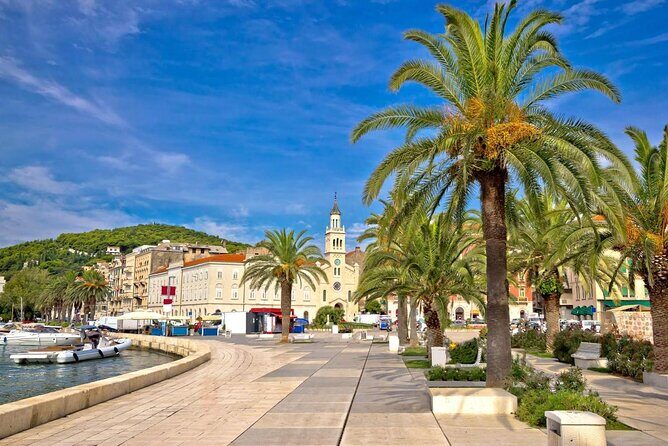
- Off-palace context at Riva and Fruit’s Square to show what changed after the Romans
- A pass by Split Synagogue that adds the city’s Jewish story without turning it into a long detour
Why Diocletian’s Palace still runs Split
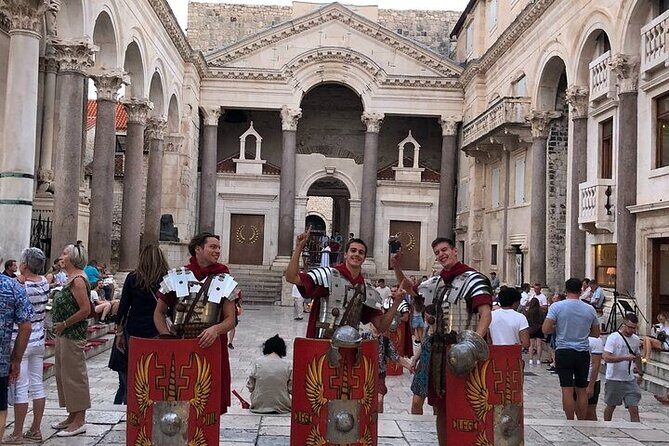
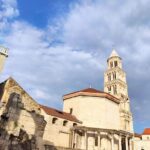
Split’s best advantage is simple: it’s not a museum city. It’s a city that grew around one of the biggest Roman statements ever made. Even if you’ve seen photos of Diocletian’s Palace before, the big shift happens when you’re walking inside it—because the palace wasn’t just walls. It was the system. Streets, thresholds, entrances, and underground spaces all point to how power was organized.
This tour leans into that. You start with the Palace’s central organizing space, then you move outward into gates, harbor views, and nearby squares. The story thread is Diocletian’s rise and authority, then what happened after his Roman world—Venetian influence, Jewish community history, and the way local culture absorbed all of it.
You can also read our reviews of more walking tours in Split
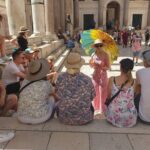

Starting at the Peristyle: your quick map of the whole Palace
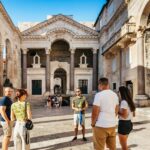
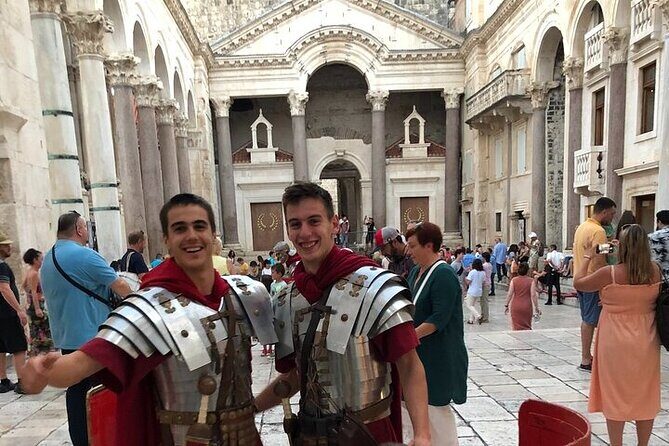
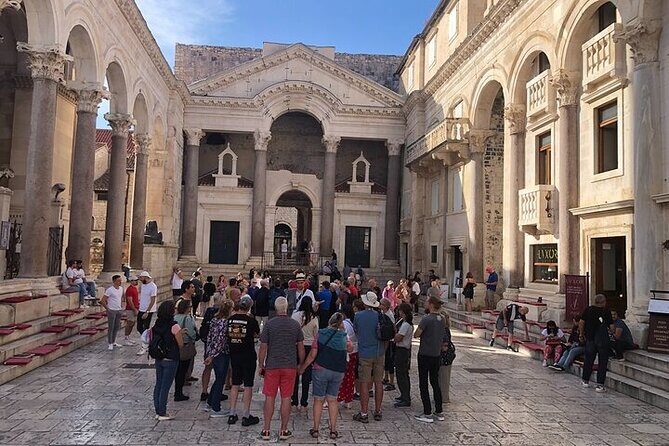
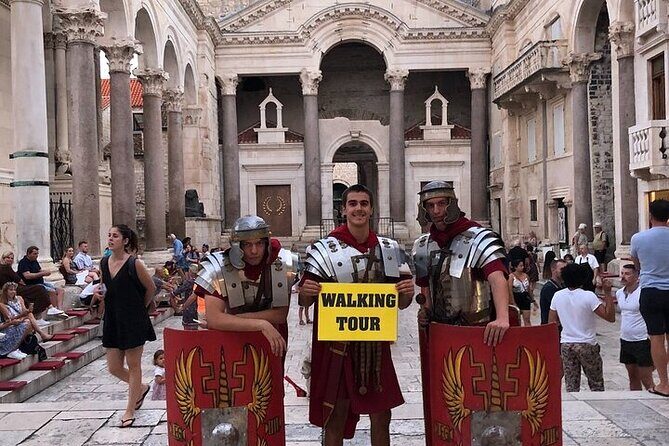
Your first stop is the Peristyle, the central square of Diocletian’s Palace. Think of it as the Palace’s hub: from here you can reach many other key spots. In practical terms, this is where the guide helps you get your bearings fast—which matters in Split, where streets can feel like a maze until someone anchors you.
Because this is the central point, it’s also where you learn the basic logic of the place. Once that clicks, the rest of the walk feels less like random sightseeing and more like following a plan. The Peristyle stop is short, but it’s one of the most important moments of the whole experience.
Jupiter and the “divine father” angle
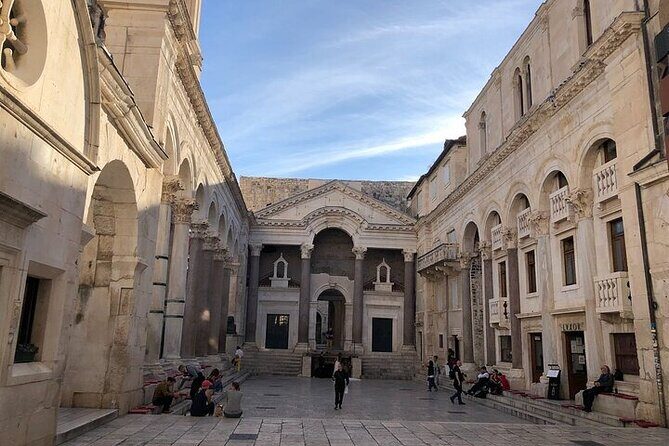
After the hub, the tour takes you toward a Roman temple dedicated to Jupiter. The key idea here isn’t just that Jupiter existed. It’s how Diocletian thought about legitimacy. Jupiter, as a divine father figure, becomes part of the explanation for how Diocletian positioned himself as something more than a politician or commander.
This is a smart stop because it changes what you see next. Roman ruins can feel generic if you only look at stone shapes. When you know what the Romans were trying to claim—spiritual connection, authority, lineage—the architecture starts to make sense.
The Palace substructures: the “what’s underneath” lesson
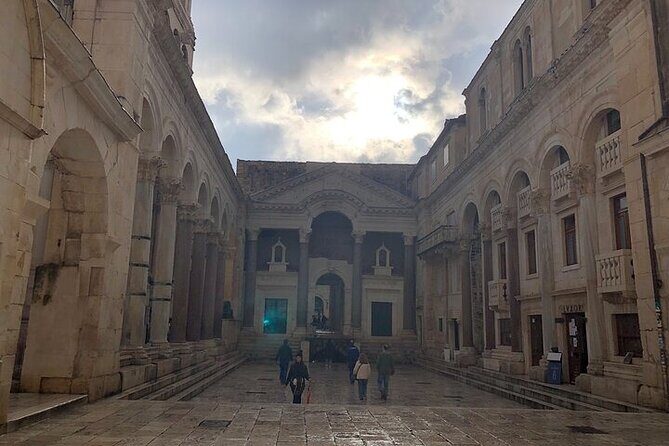
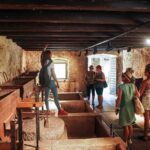
One of the main themes of this walk is how Diocletian’s Palace used its spaces over time, and that’s where the Diocletian Palace substructures come in. You’ll walk through areas connected to the construction story and what these spaces were used for as centuries passed.
A big benefit: you’re not stuck in a museum room. The tour note says you won’t visit the museum part of the substructures, and you can go for that separately afterward if you want it. That keeps the walking tour moving, and it also gives you control. If you’re curious, you can add the museum. If you’d rather stay out in the open air and keep the pace, you can.
Also, the itinerary includes substructures again later. So you’re not just seeing one moment—you get a second pass that helps it feel connected to the rest of the story.
Golden Gate and Gregory of Nin: Roman entry turns local
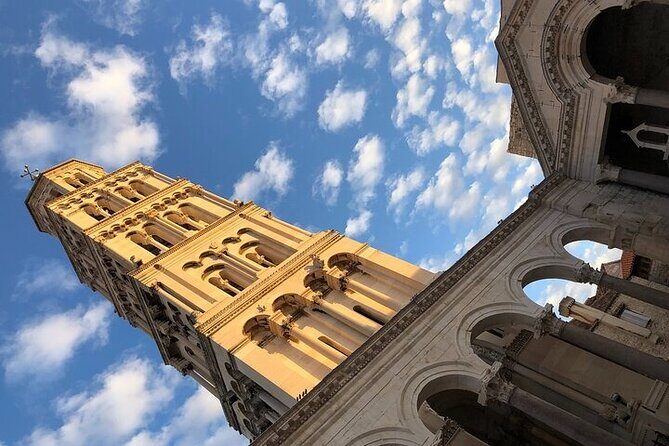
Next up is the Golden Gate, the main entrance of Diocletian’s Palace. This is one of those places where a little interpretation pays off big time. You get the background on the entrance itself, and you’ll also see the statue of Gregory of Nin, tied to the importance of his role in local history and language.
This is more than a statue stop. It’s a reminder that Split didn’t freeze in Roman time. The city reinterpreted the space, and figures like Gregory of Nin matter because language and identity are part of the story. If you care about how cultures layer—Roman to later Christian influences to modern Croatian identity—this stop delivers.
You can also read our reviews of more private tours in Split




Riva Harbor: model views and the promenade story
From the Palace zone, you shift toward the Riva Harbor area. You’ll see a bronze model of Diocletian’s Palace—perfect for making sense of what can be hard to visualize while you’re walking among real ruins. Models work best when the guide also explains what you’re looking at, and here the tour links the model with the broader story of the Riva promenade.
This is a good change of pace. After focusing on Roman architecture and imperial thinking, you get a local view of how people actually enjoy the space today. Even if you only plan to walk a little along Riva after the tour, you’ll start to understand why this waterfront promenade became such a key part of Split.
Fruit’s Square (Trg Brace Radic): Venetian layers and Marko Marulić
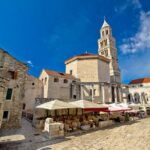
Then you reach Fruit’s Square (Trg Brace Radic). The tour connects the area to a Venetian citadel from about the 15th century and explains why that matters. Venetian influence isn’t just a date on a timeline; it shows up in the way cities organize space and power.
You’ll also learn about Marko Marulić, described as the father of Croatian literature. This is a valuable stop because it keeps the story from being only architectural. When you hear why a named person matters, the city becomes more than stones and gates. It becomes a place where ideas and language had real roots.
Passing the Split Synagogue: a quick chapter you shouldn’t skip
The itinerary includes a pass by the Split Synagogue, a 16th-century building. You don’t go inside as part of the tour experience, but you do learn about the history of the Jewish people in Split. Admission for this stop is noted as not included, so don’t count on the tour covering entry if you decide you want to see more.
I like this approach because it keeps the walk in rhythm, while still making space for a story that’s easy to miss if you only focus on the Palace. It also fits well with Split’s identity: different communities lived here, and the city’s layers are visible if you know where to look.
Vestibulum of Diocletian’s Palace: a sensory moment, not just facts
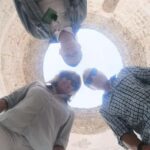
Near the end, you’ll see the vestibulum of Emperor Diocletian’s Palace. This is another “you’re here, look at this” stop where the guide explains what it is and why it matters.
The tour also notes the possibility of traditional Dalmatian singing. You should treat that as a maybe, not a guaranteed performance. But even the chance adds something important: it nudges you from history-as-text into history-as-living culture. When you’re walking through layers of empire, hearing something local can make the whole experience feel more human.
Price and logistics: is $63 worth it?
At $63.05 per person for about 1 hour 30 minutes, the price sits in the mid-range for Split guided walks, especially because this is a private tour (only your group). What you’re paying for isn’t just someone reading facts. You’re paying for guided interpretation in Spanish, plus a route that links multiple landmarks instead of treating them like separate photo ops.
A couple value notes that matter in real life:
- Many stops are free to view from public areas, and the tour includes the key “where to look” guidance.
- No admission tickets are included, and the substructures museum part isn’t part of the walk. So if you’re the type who wants everything open and paid, you may add costs later.
- It uses a mobile ticket, which saves you from paper hunt-and-scratch at the start.
If you’re traveling as a pair or small group and you want the pace of a private conversation—asking questions, adjusting speed, and staying on the story—this kind of tour usually feels like good value.
What to do before you go (so you enjoy it more)
To get the most out of a Palace-focused tour, I’d prep with two simple habits:
- Wear shoes you trust on uneven stone. Even when the route is planned, your footing is still your responsibility in old-city areas.
- Have one question ready about what you think you know. When you ask early, the guide can steer your attention, and the stops feel sharper.
Also, plan for sun and wind. Split can be comfortable, but you’re walking through outdoor spaces, including the Palace area. Bring water, and don’t pack too much. You want your hands free for photos and for the moments where the guide points you toward details.
Who this Spanish tour is best for
This is a strong choice if you:
- want a Spanish-language explanation of Diocletian’s Palace and what the city became afterward
- like a focused route that prioritizes highlights rather than long museum time
- prefer a private format where you can ask questions without feeling rushed
It’s also a good fit for first-timers to Split who want orientation. The Peristyle start is basically a built-in map lesson.
It’s less ideal if you have trouble with high steps or anything that makes older-stone walking uncomfortable. The tour is short, but the environment can still be demanding.
Should you book this Private History Split Walking Tour in Spanish?
If you’re trying to choose between quick photos and real understanding, I’d lean toward booking. This walk is built around the key Palace spaces that explain how Split is shaped—Peristyle, substructures, Golden Gate, and the surrounding context at Riva and Fruit’s Square. You’ll also get the extra layers that make the city feel complete: Gregory of Nin and language, the Venetian-era setting, and a synagogue stop that adds the Jewish chapter without turning the tour into a long detour.
Skip it only if you know you can’t handle uneven stone or high steps, or if you already know you want a full museum-style visit of the substructures interiors (because the museum portion isn’t included and you’d need to add it yourself).
FAQ
How long is the Private History Split Walking Tour in Spanish?
It’s about 1 hour 30 minutes.
Is this tour private or shared?
It’s a private tour/activity, so only your group participates.
What language is the tour in?
The tour is in Spanish.
What does the tour include?
The tour is led by an educated guide with knowledge of the Palace and surrounding locations.
Are admission tickets included?
No. Gratuities are also not included, and admission tickets are not included as part of the tour.
Which stops will we see during the walk?
You’ll see the Peristyle, learn about the Roman temple of Jupiter, pass through Diocletian Palace substructures, visit the Golden Gate, view Riva Harbor and a bronze model, learn at Fruit’s Square (Trg Brace Radic), pass by the Split Synagogue, and see the vestibulum of Diocletian’s Palace.
Where does the tour start and end?
It starts at Peristil ulica (Peristil ul., 21000, Split). It ends near Diocletian’s Palace (Grad, Split). The guide can take you back to the Peristyle if you ask.
Is the tour suitable for people with mobility concerns?
It’s not recommended for travelers who have issues with high steps.
What’s the cancellation policy?
You can cancel for free up to 24 hours in advance for a full refund.