REVIEW · CITY TOURS
Evening Group Walking Tour – Split Old City Diocletian’s Palace
Book on Viator →Operated by Adria Mice · Bookable on Viator
A Roman palace gets romantic at night. This evening walking tour of Diocletian’s Palace is built for that post-sunset calm in Split, when you can take in UNESCO-listed Roman sights without cooking in the heat. Two things I really like: the energy of guide Duje, and the way the route focuses on the palace heart—Peristyle Square, underground cellars, and the major churches—so you leave with a solid first sense of the place.
One consideration: it’s weather-dependent and short (about 1 hour). If rain rolls in, the plan may shift to a different date, so build in flexibility.
In This Review
- Key things to know before you go
- Split at night: why Diocletian’s Palace feels different after sunset
- Price and value: what $21.69 buys you in 1 hour
- Meeting point, ending point, and how the timing shapes your evening
- Walking through Old Split: the palace story in a single route
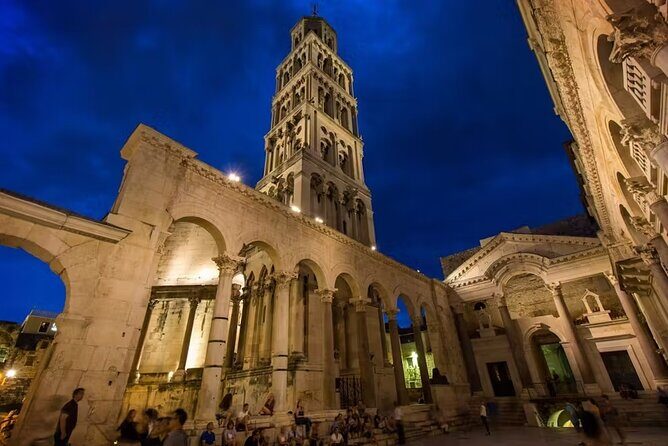
- Peristyle Square: where first impressions click
- Underground cellars: the mood shift that adds real depth
- Temple of St. Jupiter and Cathedral of St. Duje: seeing how power and faith overlap
- The cathedral stop you’ll actually remember: a landmark with context
- What you really get from a professional licensed guide
- Group size and comfort: max 25 keeps it human
- Tickets, weather, and staying flexible
- Who should book this evening palace walk?
- Should you book this Split Old City Diocletian’s Palace evening tour?
- FAQ
- How long is the Split evening walking tour?
- What is the tour start time?
- Where does the tour start and end?
- What will I see on the walk?
- Is the ticket mobile?
- How many people are in the group?
- What happens if the weather is poor?
Key things to know before you go
- Guide Duje brings big, friendly energy, with clear explanations and fact-checking when online info gets it wrong.
- Night timing helps you enjoy Diocletian’s Palace more comfortably and see it lit up.
- You’ll cover the palace core fast, including Peristyle Square, underground cellars, Temple of St. Jupiter, and Cathedral of St. Duje.
- Small-group size (max 25) keeps the walk from feeling crowded and makes Q&A easier.
- Mobile ticket means less fuss—just show your pass and start walking.
- The tour ends by Church and Convent of St. Francis, so it can fit neatly into an evening itinerary.
Split at night: why Diocletian’s Palace feels different after sunset
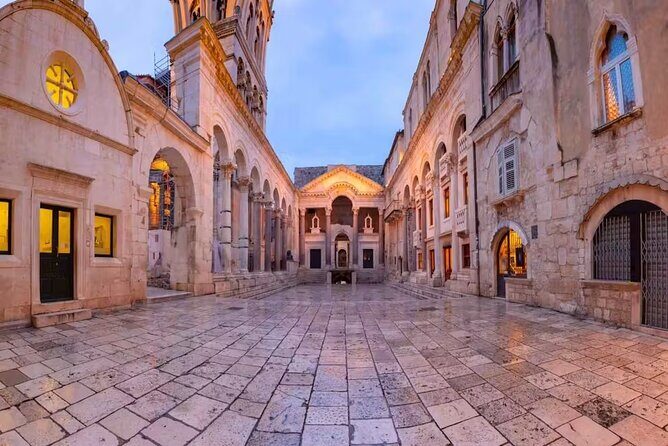
Split’s old center can feel like it’s glowing from the inside after dark. That’s the whole idea behind doing this as an evening walk instead of a daytime slog: you get the same Roman setting, but with a calmer pace and cooler temperatures. The tour is designed for people who want the atmosphere—romantic, relaxed, and very “walk right into ancient times.”
The big win is that you’re not wandering randomly. In just about an hour, you’ll move through Old Split and the parts of Diocletian’s Palace that connect directly to what most visitors want to understand first: where the palace is, what the major spaces were for, and why this complex became the center of daily life. It’s UNESCO-listed for a reason, but on foot at night, the place also reads like a living neighborhood.
You’ll also get a guide who knows how to keep the story tight. Reviews consistently highlight Duje’s enthusiasm and charisma, and that matters more than people expect. When your guide is animated and clearly enjoys the subject, the details land. You also get more confidence that you’re not picking up myths along the way—one reviewer even noted corrections to incorrect info they’d seen online.
You can also read our reviews of more walking tours in Split



Price and value: what $21.69 buys you in 1 hour
At $21.69 per person, you’re paying for a licensed guide and a structured route through one of the most famous historical sites in Croatia. The value here isn’t just the sights—it’s the time and clarity. If you go on your own, you can absolutely wander the palace streets. But you’ll likely spend that hour doing guesswork: where you are, what you’re looking at, and which features mattered most.
This tour keeps it efficient. You get a professional licensed guide, a set route with major stops, and a walk that’s short enough to feel manageable even if you’re jet-lagged or simply don’t want a long daytime commitment.
Also, the tour notes admission as free for the included sights. That’s another small but meaningful value point: you’re not paying extra to access the stops that are central to the route.
Meeting point, ending point, and how the timing shapes your evening
Start time is 7:30 pm, and the tour lasts about 1 hour. That timing is perfect for catching the palace when it’s still active but not hot. It also gives you flexibility afterward—either to continue strolling on your own or to grab dinner nearby without feeling like you lost your whole night to sightseeing.
Your start point is Split sign, Grad, Split, Croatia. Your walk ends in front of the Church and Convent of St. Francis at Trg Franje Tuđmana 1, 21000, Split. Ending here is practical. It places you back in a lively central area rather than dropping you far from restaurants or evening routes.
There’s no pick-up included, so plan to make your own way to the meeting spot. The good news: the tour is listed as near public transportation, so if you’re using transit during your stay, you should be able to fit this into your plan without major hassle.
Walking through Old Split: the palace story in a single route
This is an evening walking tour focused on the old part of Split inside Diocletian’s Palace—an approximately 1,700-year-old complex that became woven into the city. The route is designed to help you understand the palace as more than just a set of ruins. You’ll see spaces that show how Romans built monumental architecture, and how the city later turned that architecture into everyday life.
Here’s what you can expect to connect in your mind as the guide leads you along:
- Peristyle Square: Think of this as one of the palace’s central visual anchors. It’s the kind of space where your brain immediately switches from modern streets to Roman grandeur.
- Underground cellars: This is where the palace feels more mysterious and more functional. You’re stepping into the layered history of a place that served practical needs as well as ceremonial ones.
- Temple of St. Jupiter and Cathedral of St. Duje: These stops help you see how religious life and political life overlap over time in Split.
The tour is built around that sequence, so by the time you reach the end, you’re not just looking at landmarks—you’re making connections.
Peristyle Square: where first impressions click
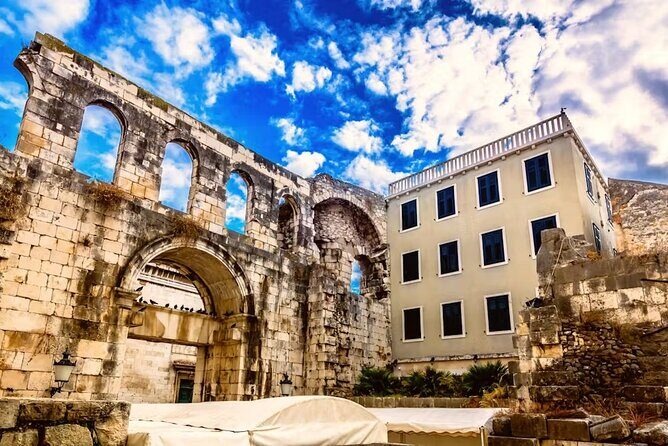
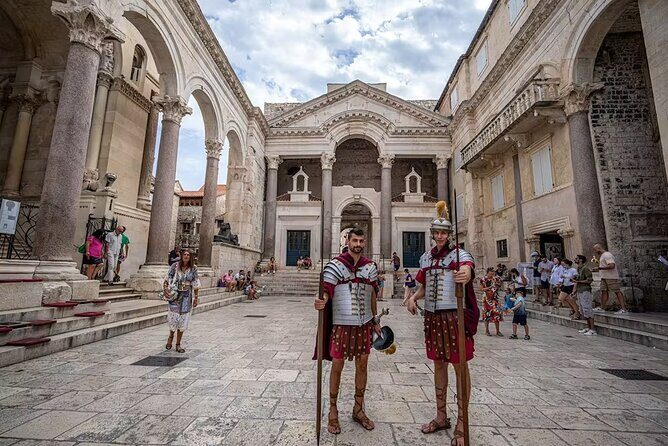
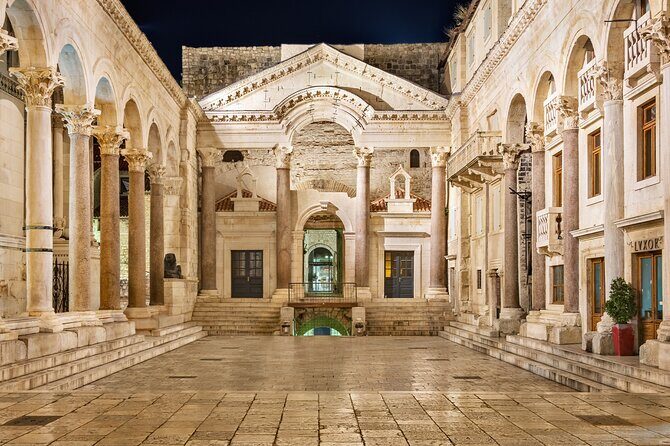
Peristyle Square is one of those stops that can look impressive from a distance, but it’s better when you understand what you’re looking at. The tour uses it as an early foundation, so you don’t spend the whole evening asking what each building is or why it’s placed there.
What I like about starting with spaces like this is that it anchors the rest of the walk. When you have one clear reference point, it becomes easier to interpret the smaller passageways and side areas you’ll pass along.
Even if you’re not a hardcore architecture person, this kind of orientation is exactly what you want on a first trip to a major old town. One review called it a helpful way to get your bearings, and that matches the purpose of a short evening orientation-style walk.
If you’re sensitive to crowds, night timing can help. You’ll still be in a famous area, but you’re less likely to feel stuck in peak midday chaos.
You can also read our reviews of more city tours in Split





Underground cellars: the mood shift that adds real depth
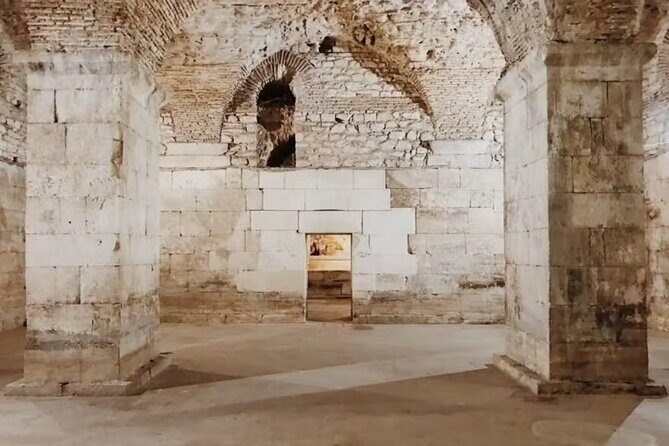
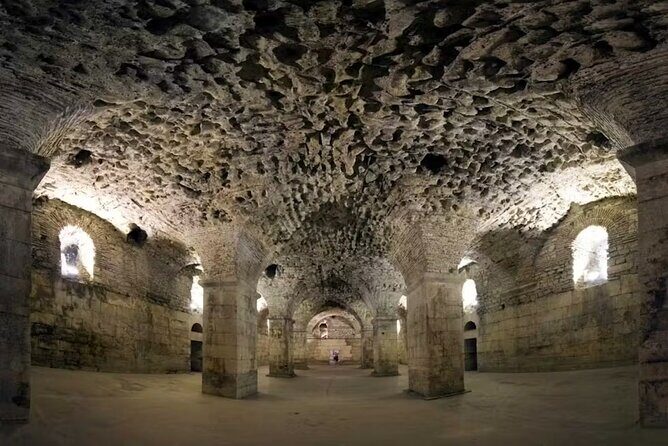
Underground cellars are where Diocletian’s Palace stops being just a pretty evening backdrop and becomes something you can feel. The palace wasn’t only built for looks; it had systems and storage. Going underground also changes the mood. Light, air, and the sense of scale tend to make these stops stick in your memory.
In a 60-minute tour, you want at least one or two stops that feel different from the street-level sights. Cellars are that contrast. They add variety without blowing up the schedule.
If you’re the type who likes historical places but hates when tours feel like a lecture, this is a good balance. You’re walking, looking, listening, and then switching mental gears as you move from monumental open space into more enclosed, functional areas.
Temple of St. Jupiter and Cathedral of St. Duje: seeing how power and faith overlap

The Temple of St. Jupiter and the Cathedral of St. Duje are listed stops, and they work well as a paired comparison. Even without going deep into extra details beyond what you’re shown on the walk, you’ll see the story arc of how authority and belief show up in stone.
This is also where an energetic guide matters. Reviews specifically mention Duje correcting wrong information floating around online, which is a big deal at sites like this where the internet can be confident and wrong at the same time. If you care about getting the story straight, you’ll appreciate that.
For you, the payoff is simple: by the time you’ve finished these stops, you’ll understand what makes the palace not just a Roman relic, but a continuing part of Split’s identity.
The cathedral stop you’ll actually remember: a landmark with context
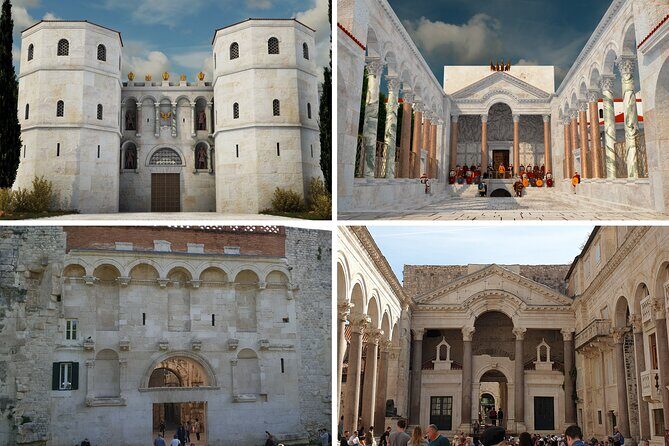
Cathedral of St. Duje is another stop that tends to stick because it’s visible and emotionally recognizable once you’re standing there. In many old towns, big churches can feel like they exist in a vacuum—separate from the rest of the city. In this tour, the guide’s route connects it back to the palace setting.
That connection is what turns a single landmark into a better story. You don’t just see a church. You see how the palace became integrated into the life of the city.
And because this is an evening tour, you may notice the atmosphere more. Stone and religious architecture often look especially dramatic under lower light, and your guide’s pacing helps you slow down at the right moments.
What you really get from a professional licensed guide
You’re not paying only for walking. You’re paying for interpretation. This tour includes a professional licensed guide, and the reviews make it clear that Duje doesn’t just recite facts. He brings enthusiasm, keeps the group engaged, and seems genuinely invested in helping people connect with the place.
I think this is the biggest reason people rate it highly. A short tour is only worth it if you come away feeling smarter, not just tired. With a guide who is fun and energetic, the information becomes easier to hold onto—especially when you’re moving from square to cellar to temple to cathedral without a long sitting break.
If you’re visiting Split for the first time, this kind of orientation can also help you plan the rest of your stay. You’ll have a mental map of how Diocletian’s Palace threads through the city, which makes later self-guided wandering much easier.
Group size and comfort: max 25 keeps it human
The group max is 25 travelers. In practice, that size helps a lot. Small enough that you’re not constantly bumping shoulders, but large enough that the tour still runs efficiently.
Most travelers can participate, and service animals are allowed. The tour is also near public transportation, which reduces stress if you’re hopping around Split during your evening.
One thing to expect with any 1-hour walking tour is that you’ll move along at a steady pace. You’ll probably not have long breaks to wander off-script. That’s not a drawback so much as the trade-off you’re choosing for a compact, high-value orientation.
Tickets, weather, and staying flexible
This is a mobile ticket experience. That’s a comfort factor. Less paper, less searching, more time focused on the walk.
Weather is the other key point. The tour requires good weather. If it’s canceled due to poor weather, you’ll be offered a different date or a full refund. So if you’re planning a tight schedule, I’d treat this as one of your “nice-to-have” evening activities rather than a must-do that can’t move.
A quick practical tip: since it’s evening, bring a light layer even if daytime is warm. Split can feel cooler at night, especially after the sun drops, and you’ll enjoy the walk more if you’re comfortable from start to finish.
Who should book this evening palace walk?
This tour is a strong fit if:
- you want an easier first impression of Split without a long daytime commitment
- you like history but prefer stories that stay fun and organized
- you’re trying to avoid summer heat and still see Diocletian’s Palace in great lighting
- you’d rather pay for a guide to save time than figure everything out solo
It may be less ideal if:
- you need a lot of free time to roam beyond the route, since this is about a structured walk
- you’re traveling during an uncertain weather stretch and hate schedule changes
Should you book this Split Old City Diocletian’s Palace evening tour?
If you want a quick, guided orientation to one of Europe’s most famous historical complexes, this is a smart booking. The price is reasonable for a licensed guide and a focused route. The evening timing is the real secret sauce: cooler feet, better atmosphere, and palace lights that make the whole setting feel extra special.
I’d book it if you’re doing Split for the first time or if you want one guided activity that makes the rest of your trip easier. With Duje leading—energetic, engaging, and willing to correct incorrect info—you’re likely to come away feeling oriented, not just entertained.
If you’re the type who hates being rushed, consider the one-hour format carefully. Otherwise: grab your mobile ticket, aim to arrive at the meeting spot with a little time buffer, and enjoy walking through a Roman palace that still lives as a real part of Split.
FAQ
How long is the Split evening walking tour?
It’s approximately 1 hour.
What is the tour start time?
The start time is 7:30 pm.
Where does the tour start and end?
It starts at Split sign, Grad, Split, Croatia, and ends in front of the Church and Convent of St. Francis, Trg Franje Tuđmana 1, 21000, Split.
What will I see on the walk?
You’ll visit highlights including Peristyle Square, underground cellars, the Temple of St. Jupiter, and the Cathedral of St. Duje, along with other parts of Old Split inside Diocletian’s Palace.
Is the ticket mobile?
Yes, this experience uses a mobile ticket.
How many people are in the group?
The tour has a maximum of 25 travelers.
What happens if the weather is poor?
The experience requires good weather. If it’s canceled due to poor weather, you’ll be offered a different date or a full refund.