REVIEW · DIOCLETIAN'S PALACE
Chill Private Walking Tour of Diocletian’s Palace
Book on Viator →Bookable on Viator
Diocletian’s Palace makes more sense on foot. I love the private pace and the way Mili connects the street-level ruins to 3D reconstructions, so you can picture what you’re seeing. You also get a clear story of Roman power and later reuse without feeling rushed.
One thing to plan for: several stops offer optional interior tickets, so your time and total cost can shift a bit if you decide to go in.
In This Review
- Key highlights you’ll feel right away
- Diocletian’s Palace, in one guided walk
- Price and what you’re really paying for
- Where you start and how the route finishes
- Stop 1: The Peristyle of Diocletian’s Palace
- Stop 2: Substructures—free parts first, museum option if you want more
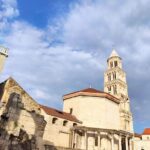
- Stop 3: Cathedral of Saint Domnius—Roman tomb to cathedral
- Stop 4: Temple of Jupiter—repurposed, still remarkably preserved
- Stop 5: Triklinij—partial reconstruction and a sense of daily life
- Stop 6: Papalićeva ulica—facts in the north half
- Stop 7: Fruit’s Square (Trg Brace Radic)—where palace meets newer Croatia
- Stop 8: The Golden Gate—fortifications and their changing role
- Stop 9: Grgur Ninski statue—tying the story to Croatia
- The guide factor: why Mili’s style works
- When to go and what to wear for comfort
- Who should book this private palace tour?
- Should you book this tour?
- FAQ
- What’s the duration of the Chill Private Walking Tour of Diocletian’s Palace?
- How much does the tour cost?
- Is the tour offered in English?
- What’s included in the tour?
- Are any entrances included?
- Where does the tour start and end?
- What if the weather is bad?
- Is this a private tour?
- What’s the cancellation policy?
Key highlights you’ll feel right away
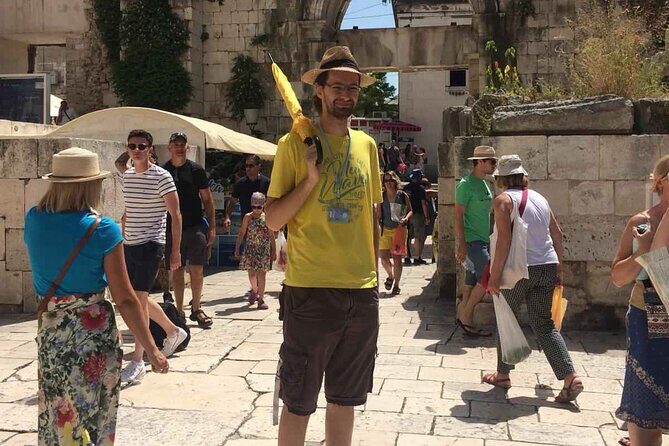
- Peristyle start: you get oriented fast, before you wander into the details.
- 3D reconstructions for comparison: you can match today’s ruins to how they once looked.
- Roman-to-Christian transformations: see how the palace’s sacred spaces changed over time.
- Triklinij partial reconstruction: an impression of how Diocletian’s life may have looked in that corner.
- Croatian history outside the palace walls at Fruit’s Square and the Grgur Ninski area.
- Private group up to 15 keeps questions welcome and pacing flexible.
Diocletian’s Palace, in one guided walk
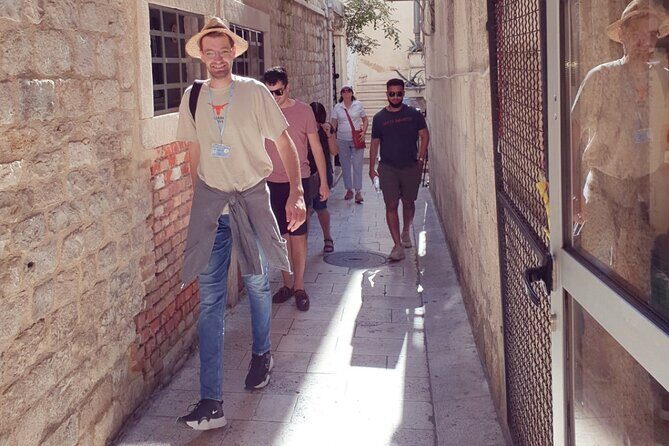
Split’s Diocletian’s Palace is one of those places where first-time visitors often feel the same thing: the walls are huge, the rooms are layered, and it’s hard to know what you’re looking at. This private walking tour solves that by giving you a guided route that moves in a logical order, from the palace’s ceremonial core to the gates and then out into the wider historic setting.
What I like most is how the tour treats the palace like a living puzzle. You don’t just hear dates. You learn what each space was for, how it fits into the palace plan, and how later cultures reused the structures instead of erasing them. Even if you’re not a die-hard architecture person, the stops are chosen to help you build a mental map of the complex.
And because it’s private, the pace feels calmer than a typical group tour. You can ask questions, linger when something catches your eye, and still finish with a clear sense of the whole site.
You can also read our reviews of more walking tours in Split

Price and what you’re really paying for
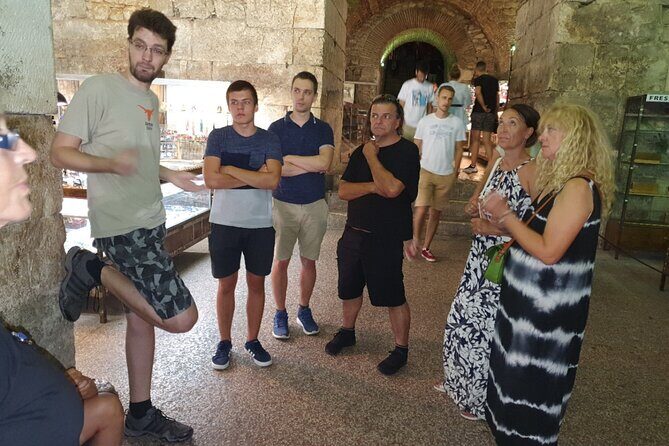
The price is $107.84 per group, up to 15 people, and the tour runs about 1 hour 30 minutes to 2 hours. On paper, that sounds like a lot if you’re traveling solo. On the other hand, it’s a strong value when you’re splitting the cost with family or friends, because the price is grouped, not per person.
Here’s the practical takeaway: you’re paying for a guide who can interpret what you’re seeing, plus tools to make the visuals click. The tour uses comparisons with 3D reconstructions (you’ll see the idea right away at multiple stops). That kind of context is hard to get from a quick self-walk through streets and stones—especially in a layered site like this, where Roman design meets later reuse.
Also, remember that a few interiors are optional. If you skip all interior tickets, you’re mostly on the “walk-and-understand” version. If you add them, you’ll spend a little more and the tour will stretch closer to the longer end of the time window.
Where you start and how the route finishes
The tour begins at the Eastern (Silver) Gate, at Poljana kraljice Jelene 5, Split. You’ll end at the Golden Gate area, at Dioklecijanova 7, and the final stop is outside the northern gate by the bronze statue of Grgur Ninski.
This matters because Diocletian’s Palace can feel like a maze if you enter randomly. Starting at a gate gives you instant orientation: you’re entering the story from the edges, then moving inward and onward. Ending near Grgur Ninski helps you “close the loop,” shifting from the Roman palace construction to later Croatian identity in the same walk.
The meeting point is also near public transportation, which is handy if you’re mixing this with other things in Split. For a tour like this, I’d plan to arrive a few minutes early, so you’re not trying to find the right gate while your guide is starting the first explanation.
Stop 1: The Peristyle of Diocletian’s Palace
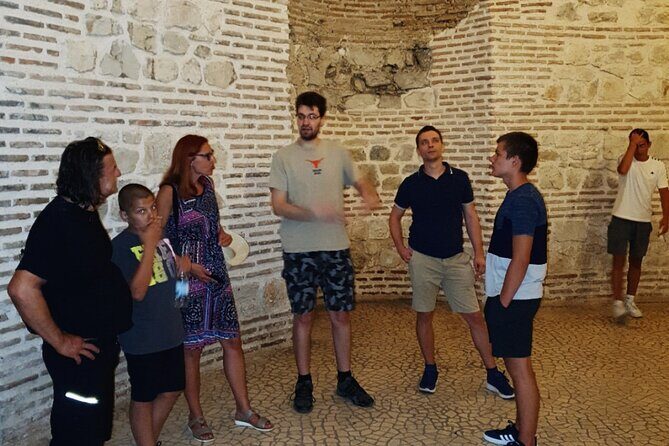
You start in the Peristyle, the palace’s grand central space. This is a smart opening move because it’s where you can grasp the palace as more than a pile of ruins. You’ll learn about Diocletian and why this palace existed where it did, which sets the tone for every stop that follows.
This first stop is also where the 3D reconstructions do their best work. Standing in the Peristyle, you can better understand what “center” means in the palace plan—how spaces relate to each other, and how impressive the setting was when it was intact. Even if your main interest is Roman history, you’ll leave stop one with clearer expectations for the rest of the walk.
Time-wise, you’ll spend about 20 minutes here. That’s long enough to get oriented without eating your whole tour. If you like learning in a structured way, this opening is the kind of start that prevents confusion later.
Stop 2: Substructures—free parts first, museum option if you want more
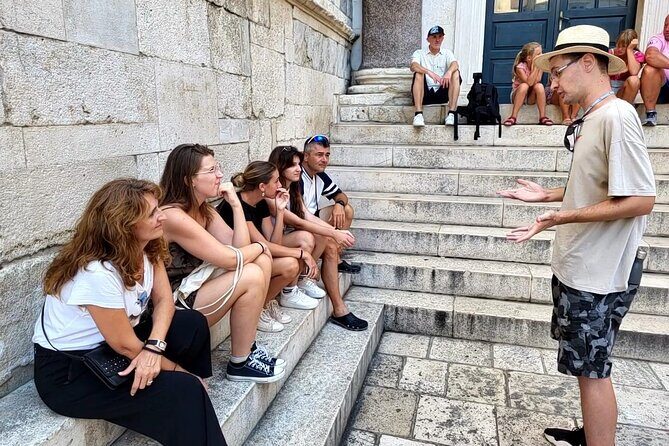
Next, you move into the palace’s substructures. The tour focuses on the free areas, where you can understand the palace’s architecture and history without buying interior tickets right away. This is a good approach for mixed groups because it keeps the tour accessible while still offering depth for anyone curious.
If you want to see more, you can purchase tickets for the museum part of the substructures, and your guide will include the rest. Adding that option brings roughly 20 extra minutes to the tour.
This stop is one of the places where a guide earns their fee. Substructures can feel confusing when you only see the surface. With a guide, you get the “why” behind the layout—how the palace was designed to function and how those spaces fit into daily life within the complex.
My advice: if you think you’d enjoy more detailed interior viewing, consider the museum option early. If you’re on the fence, start with the free portion. You can decide as you go based on how your group feels.
You can also read our reviews of more private tours in Split





Stop 3: Cathedral of Saint Domnius—Roman tomb to cathedral
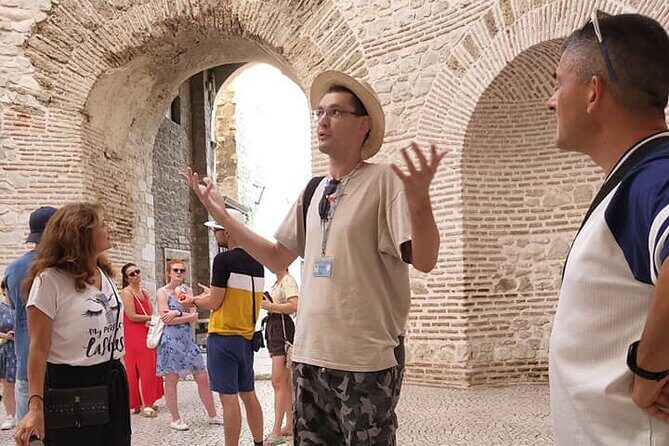
Then you reach the Cathedral of Saint Domnius, one of the best-preserved Roman structures tied to the palace. This is a standout stop because it explains the survival of Roman architecture in a way that feels physical, not abstract.
You’ll learn how the space connects to Diocletian’s palace—and then, if you have a cathedral ticket, you can go inside. The inside visit focuses on how a Roman tomb was converted into a Christian cathedral, adding about 10 more minutes.
Even if you don’t go inside, the conversation matters. Many historic sites turn into “pretty stones” without context. Here, you get a straightforward story of reuse: the building didn’t just survive; it changed roles while staying itself.
If your group enjoys the human story of how beliefs and power shifted, this stop is worth the extra time and ticket. If your group prefers outdoor viewing, you’ll still get the core understanding from the exterior and explanation.
Stop 4: Temple of Jupiter—repurposed, still remarkably preserved
From there, you visit the Temple of Jupiter, another well-preserved Roman structure. Like Saint Domnius, it also had later Christian reuse, and that ongoing repurposing is part of what makes it fascinating.
The tour handles this flexibly:
- Outside, you’ll get the key points about the temple and its preservation.
- With a ticket, you can see the small interior.
Either way, you’ll spend around 10 minutes on this stop.
This is a great place for people who like “how can this still be here?” questions. Roman architecture often survives when it’s repurposed, maintained, or built into later eras. Seeing how the church used existing sacred spaces helps you understand why Split’s center feels Roman even today.
If you’re trying to manage optional costs, you could skip the interior here. You’ll still learn the essential story outside, and your guide can tailor the pacing to keep everyone comfortable.
Stop 5: Triklinij—partial reconstruction and a sense of daily life
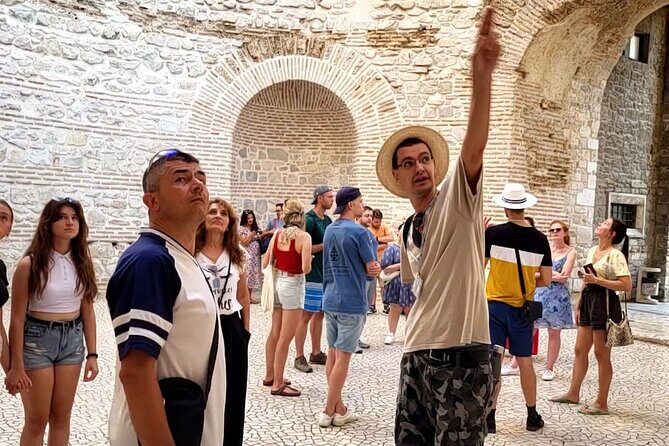
The Triklinij sits in the palace’s south-eastern area, where much is gone. But because of the way the structure was built, there’s an accurate partial reconstruction that helps you picture the setting more clearly.
This stop gives a different kind of learning: less “look at a monument” and more “imagine how people might have lived or gathered.” You get that impression of how Diocletian may have lived here, even with the parts that didn’t survive.
Expect about 15 minutes. For me, this is one of the best stops for turning a giant site into something you can mentally inhabit. You’ll also benefit from the tour’s reconstruction comparisons here, since the partial rebuild is what bridges the gap between ruins and function.
If your group includes teens, this kind of “how did it work” storytelling usually lands well, because it feels like a puzzle with an answer rather than a lecture.
Stop 6: Papalićeva ulica—facts in the north half
Then you walk through Papalićeva ulica, a palace alleyway area in the north half. This is a quieter stop, but it’s still useful because it teaches you about the palace as a designed space, not just isolated highlights.
You’ll get interesting facts as you head through this corridor of history, building connections between what you saw earlier and how the palace functioned as a whole.
The time is about 15 minutes. If you’re the kind of visitor who likes small details, this stop can be memorable because it helps you “see the palace” rather than only “see buildings.” If your group prefers big-ticket monuments only, you’ll still come away with an easier sense of layout.
Stop 7: Fruit’s Square (Trg Brace Radic)—where palace meets newer Croatia
Next comes Fruit’s Square (Trg Brace Radic), outside the palace. This stop is important because Diocletian’s Palace isn’t sealed off from the rest of Split. It’s been integrated into newer buildings and life, and that contrast is part of the story.
Here, you’ll learn about an important period of Croatian history connected to what you’re seeing around the palace. You’ll also notice the way the palace structure is folded into later development, which is why walking through Split can feel like walking through time.
You’ll spend about 15 minutes here. If you’re thinking of adding this to a broader day trip, treat this stop like the “bridge” from Roman engineering to later identity. It helps you stop seeing the palace as a frozen artifact and start seeing it as a base layer that later generations worked with.
Stop 8: The Golden Gate—fortifications and their changing role
As the tour nears the end, you see the northern gate of the palace, also called the Golden Gate. This stop brings you back to the idea of defense and movement.
You’ll learn about the palace’s fortifications and how they changed between their original construction and the present day. Even if you’re not into military history, gate areas are perfect for understanding how architecture controls flow—where people enter, what the walls communicate, and how a palace functioned as a protective unit.
Spend about 10 minutes here. It’s a short stop, but it lands as a practical wrap-up: you can trace the logic of the palace plan from center to edge, and then you’re ready for the closing moment.
Stop 9: Grgur Ninski statue—tying the story to Croatia
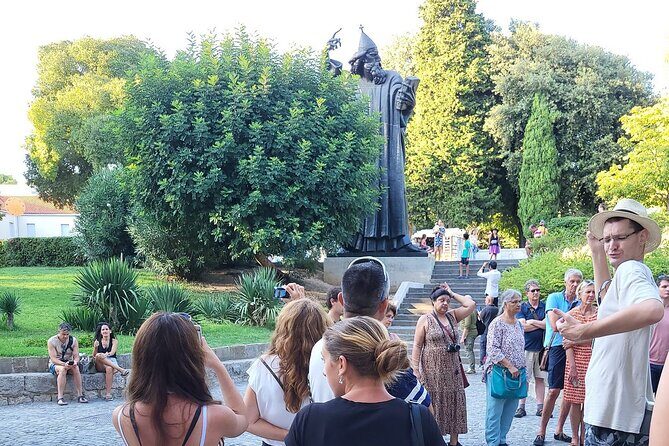
The final stop is outside the northern gate area near the bronze statue of Grgur Ninski. The guide uses this as a clean wrap-up point, helping you consolidate what you learned about Roman construction and then shifting to Croatian history so far.
You’ll spend about 15 minutes here. This ending is helpful because it prevents the classic “I saw a lot, but now what?” feeling. Ending with a named historical figure makes the story easier to carry when you walk away into Split’s everyday streets.
If you like tours that end with a sense of closure rather than a sudden stop, this ending style works well.
The guide factor: why Mili’s style works
Even with a strong route, the guide can make or break the experience. In this tour, the guide is described as passionate and able to keep things fun and engaging, and you’ll feel that in the pacing and explanations.
One theme you’ll appreciate is how the guide connects the palace to modern pop-culture references without leaving non-fans behind. If you’ve ever wondered about Game of Thrones connections in Split, you’ll likely get some of that context. If you’re not into that, you still get a full explanation of how the palace evolved and why the spaces matter.
You’ll also benefit from the way the guide uses visual tools like 3D reconstructions, which makes it easier to track what changed over centuries. The guide is also described as flexible when weather hits hard. For example, there was at least one sudden thunderstorm where the guide adjusted the route to avoid the worst conditions.
Most importantly, you’ll get a conversational vibe: good communication before and during, plus room for questions. That makes a private tour feel like learning with a local rather than following a script.
When to go and what to wear for comfort
This experience needs good weather. If conditions aren’t suitable, you’re offered a different date or a full refund. That’s not just policy language; it fits the tour style. You’re outside for most of the walk, with multiple stops at specific palace points.
If you’re traveling in warmer months, you might find it easier to enjoy the tour in the evening when the sun is less intense. One practical tip from real-world experience: bring weather flexibility. A guide who can adjust the route during sudden rain is a lifesaver when plans meet reality.
For footwear, you’re walking a lot on stone and uneven palace-adjacent surfaces. I’d plan on comfortable shoes and a water bottle. Even a short tour can feel long if you’re tired or under-prepared for outdoor walking.
Who should book this private palace tour?
This tour fits best if you want:
- A structured walk through a complex site, without guessing what each building was for
- A private group setting where you can ask questions and set your own pace within the schedule
- A guide-led explanation of how Roman architecture was repurposed later, especially at Saint Domnius and the Temple of Jupiter
- Visual support through 3D reconstructions, which is great if you learn better by seeing the “before” picture
It’s also ideal for mixed-age groups and for visitors who may not have time for a longer, multi-day deep dive. The stop timing is built around keeping momentum while still giving enough detail to matter.
If you’re a first-time visitor to Split and Diocletian’s Palace is your top priority, this is a strong first move. If you already know a lot and want only the biggest interiors, you might be tempted by the optional ticket choices—but the outdoor core is still strong.
Should you book this tour?
I think this is a smart booking if you want Diocletian’s Palace to make sense fast. The route is designed to build understanding step by step, and the combination of private pacing plus 3D reconstruction comparisons is exactly what helps a layered site click.
Book it if:
- You’re traveling with 2 to 6 people and want good value per group
- You care about how Roman and later Christian use overlap in the same buildings
- You want the story in English from a guide who keeps it engaging and adapts when weather changes
Consider skipping (or keeping interiors optional) if:
- Your group hates spending extra time or money on optional interiors
- You’re expecting a strict “only exterior” format all the way through, since ticketed interior visits can add about 10–20 minutes depending on the stop
If you’re on the fence, my advice is simple: go for the guided version. In a place like this, having someone connect the dots saves time and makes the stones feel human.
FAQ
What’s the duration of the Chill Private Walking Tour of Diocletian’s Palace?
It runs about 1 hour 30 minutes to 2 hours, depending on whether you add optional interior visits.
How much does the tour cost?
The price is $107.84 per group, up to 15 people.
Is the tour offered in English?
Yes. The tour is offered in English.
What’s included in the tour?
You get an experienced guide and comparisons using 3D reconstructions. A mobile ticket is provided.
Are any entrances included?
Some stops have optional interior tickets (for parts like the cathedral, additional substructure museum areas, and the small interior at the Temple of Jupiter). The basic route covers free areas at those stops.
Where does the tour start and end?
It starts at the Eastern (Silver) Gate, Poljana kraljice Jelene 5, Split. It ends outside the northern gate by the bronze statue of Grgur Ninski, in the Golden Gate area (Dioklecijanova 7).
What if the weather is bad?
The experience requires good weather. If it’s canceled due to poor weather, you’ll be offered a different date or a full refund.
Is this a private tour?
Yes. It’s a private tour/activity, and only your group participates.
What’s the cancellation policy?
Free cancellation is available. You must cancel up to 24 hours in advance for a full refund, and refunds are not available if you cancel less than 24 hours before the start time.