REVIEW · GUIDED
Salona & Amphitheater – Private guided tour – Admission incl.
Book on Viator →Operated by Split Guide · Bookable on Viator
Roman ruins meet real-time storytelling in Solin. This private Ancient Salona walk is a smart way to see how one city kept changing over centuries, from a Roman metropolis to an early Christian landscape. I like that the guide keeps the story moving step by step, and that the route ends at the amphitheatre, the most dramatic piece on the ground.
Two things I’d call out right away: the guide quality (Ivan is named as knowledgeable and pleasant), and the sheer variety in a short window, with necropolises, basilicas, baths, gates, and forum-area remains in one compact loop. The one catch to plan around is that it’s an outdoor route and it requires good weather, plus the Ancient Salona open-air museum entrance fee is listed as not included (about €10 for adults).
In This Review
- Key Highlights You’ll Care About
- Ancient Salona Feels Like a City That Kept Evolving
- Meeting in Solin: A Route That Keeps Momentum
- Ancient Salona Open-Air Museum: Start Where the Big Story Begins
- Manastirine: Necropolis Memory With St. Dominius in the Background
- Tusculum and the Bishop’s Palatium: Power, Faith, and Function
- The Roman Baths and the “Industrial Outside City Center” Feel
- Porta Caesarea and the Hram Area: When Roman Details Become Physical
- The 16 Sarcophagi, Kapljuc, and the Road Toward the Amphitheatre
- Salona Amphitheatre: The Best Preserved Surprise
- Price and Time: Is $203.50 Per Person Worth It?
- Weather and Comfort: The One Real Variable
- Who This Private Salona Tour Suits Best
- Should You Book This Salona and Amphitheatre Private Tour?
- FAQ
- How long is the Salona and Amphitheatre private guided tour?
- Is the tour offered in English?
- Is this a private tour?
- What ticket costs should I expect for Ancient Salona?
- Does it include a mobile ticket?
- Where does the tour start?
- Is the experience dependent on weather?
- Can I cancel for a full refund?
Key Highlights You’ll Care About
- Private, English-guided pacing that keeps you from getting lost among scattered ruins
- Roman-to-Christian storyline in 2 hours 30 minutes, not a vague museum stroll
- Amphitheatre Salona as the main visual payoff, with notes on why stones ended up in Venice
- Several sites are free to enter during the walk, so most time is spent looking, not paying
- Ruts at Porta Caesarea that make the Roman road use feel physical
- St. Dominius and martyrs tie together the necropolis stops into one clear theme
Ancient Salona Feels Like a City That Kept Evolving
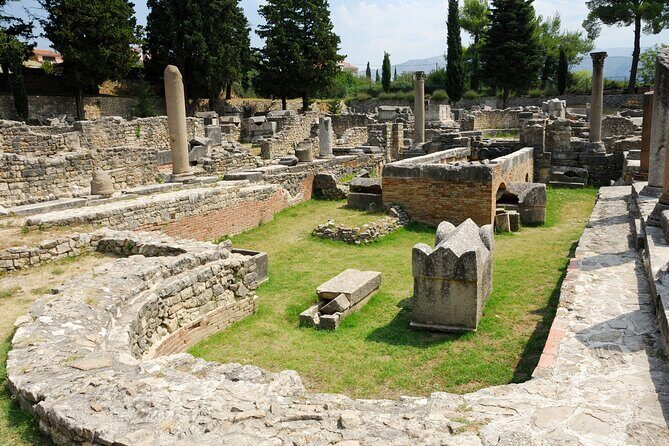
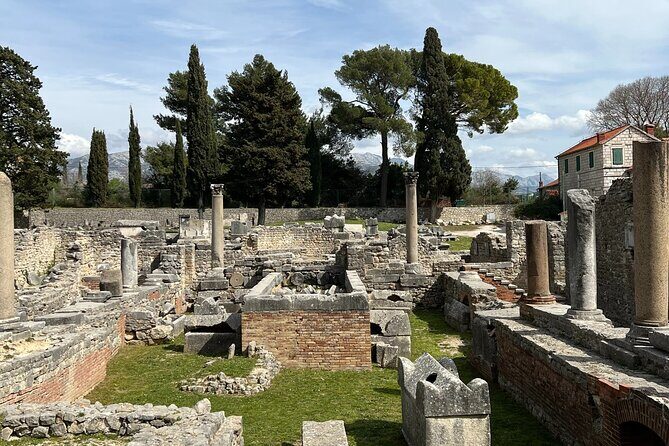
If you’ve visited Roman ruins before, you might expect a pile of columns and that’s it. Salona gives you more. You see a place that was built up, reused, reinterpreted, and then ultimately erased and repurposed by later events.
The scale sets the mood. Salona was a metropolis in Roman times with about 60,000 inhabitants until it was destroyed in the 6th century by the Avars. What makes the tour satisfying is that it doesn’t just drop big dates in your lap. It connects them to what you’re walking past: cemeteries, baths, gates, and a major amphitheatre that still looks tough despite centuries of change.
The tone is also practical. You’re not trying to win an archaeology quiz. You’re learning what each area likely meant to the people who used it—then you get to stand in the same space and see the shape of that life for yourself.
You can also read our reviews of more guided tours in Split


Meeting in Solin: A Route That Keeps Momentum
This is a private tour, so your group stays together the whole time. You meet at the Salona main entrance at Ul. don Frane Bulića 58, 21210 Solin, Croatia, and the walk loops back to the meeting point at the end.
Expect a steady rhythm. The stops are short—often around 10–15 minutes—with the amphitheatre getting about 30 minutes. That structure is ideal if your time in Split/Solin is limited, or if you know you’ll focus better with someone steering you between highlights.
Also, you’ll want to wear shoes you don’t mind for uneven surfaces. This is ancient ground, not a museum floor.
Ancient Salona Open-Air Museum: Start Where the Big Story Begins
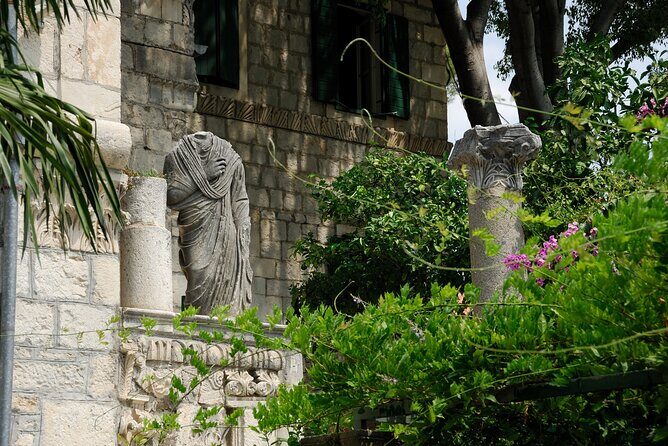
The tour kicks off at Ancient Salona, your first real chance to get oriented. You’ll start at the entrance of the open-air museum area, where the guide provides general context before you move deeper into the site.
One important planning note: the open-air museum entrance fee is listed as about €10 for adults and specifically not included. Your tour price may cover other areas, but you should budget for this one additional ticket if you’re the one paying. (If you like to travel with zero surprises, it’s worth checking this ahead of time.)
Why this stop matters: Salona isn’t just Roman-in-name. It was a major city, and the narrative here gives you the “why” before the “what.” Once you have that framework, the later Christian cemetery sites make more sense, because you can see how a place changes use over time.
Manastirine: Necropolis Memory With St. Dominius in the Background
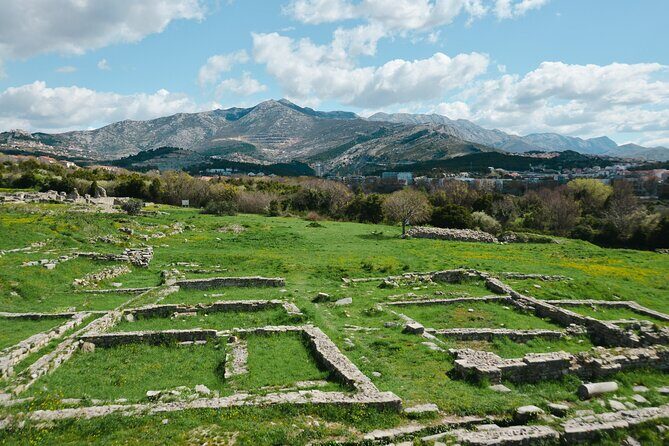
Next up is Manastirine, already a necropolis in Roman times and later used as a Christian cemetery. The guide links this place to a key local figure: St. Dominius, described as the martyr and city patron of Split.
This stop is one of those “small time, big meaning” moments. The ruins here aren’t trying to overwhelm you like a fortress might. Instead, they show how burial ground can become part of a community’s identity across eras.
Practical tip: with only about 15 minutes, don’t expect to read every stone detail. Use the time to understand the layout and the purpose of the place—then move on. That’s where a guide really helps.
Tusculum and the Bishop’s Palatium: Power, Faith, and Function
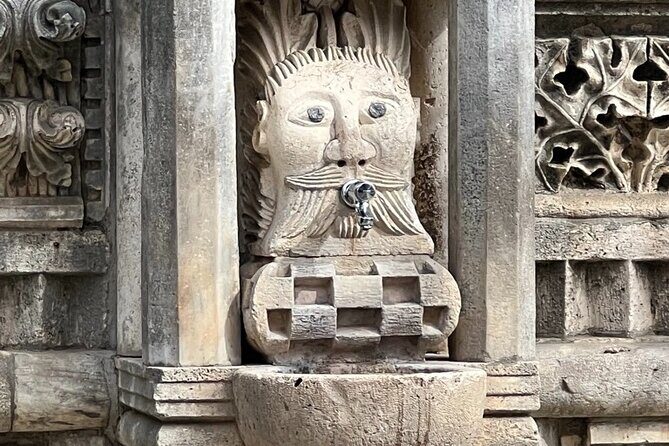
You’ll then visit two additional layers of the city’s story:
- Tusculum, built by Don Frane Bulić, a famous clergyman and archaeologist from Split. Some rooms can be visited. This is where the “archaeology today” story quietly joins the “ancient life then” story. You’re seeing how modern discovery and preservation shape what you experience.
- Biskupska palača (Palatium episcopi), the bishop’s palace and the remains of two cathedrals from the period when Christians could practice their religion freely. Today, only foundation walls remain, so it’s a stop that rewards interpretation over “wow factor.”
The benefit of these two stops back to back is clarity. You can go from Roman-era civic culture and later Christian identity without your brain feeling like it’s switching topics every five minutes.
The possible drawback is also fair: if you’re the type who wants fully standing monuments, these foundation-walls moments can feel more subtle than spectacular. Still, they’re crucial for understanding what faith looked like when power was shifting.
You can also read our reviews of more private tours in Split



The Roman Baths and the “Industrial Outside City Center” Feel
The tour includes a Large urban spa (Roman baths) used for several hundred years and described as a center of social and cultural life in Roman times.
Then you’ll move toward Pet mostova—the “five bridges”—which belonged to a kind of industrial area outside the old city center. That combination works because it shows two sides of urban life:
- social routine (baths),
- work and infrastructure (bridges/industrial edge).
You’ll likely notice the way ruins like bridges can change your sense of where the city’s limits were. Even if you’re not studying layout like a scholar, you’ll start to feel the city as a system rather than isolated attractions.
Porta Caesarea and the Hram Area: When Roman Details Become Physical
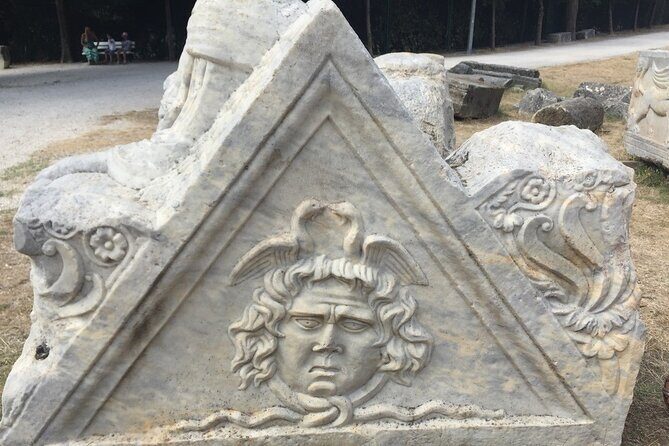
This is one of my favorite kinds of stops on any Roman site: the ones where small details make the past feel touchable.
At Town Gate – Porta Caesarea, you’ll see the capital gate in Roman times and—best of all—the ruts of old Roman chariots still visible. Those tracks don’t just look interesting; they hint at daily motion. Something heavy and wheels-based once moved here, over and over.
After that comes Hram, described as the oldest part of the city with remains of the forum, a temple, and an ancient Roman theater.
Together, these stops give you a sense of how Roman public life worked:
- gates for movement and control,
- forum and temple areas for civic/religious focus,
- theater for public gathering and entertainment.
If you’re trying to understand Roman cities quickly, this pair is a strong use of time.
The 16 Sarcophagi, Kapljuc, and the Road Toward the Amphitheatre
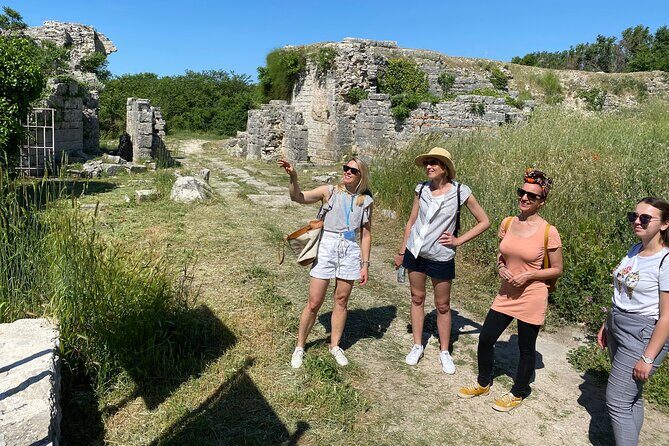
As you head toward the amphitheatre area, you’ll see two important necropolis-related stops.
First is Ul. don Frane Bulića 91, the “Cemetery of the 16 Sarcophagi.” Roman cemeteries were built outside city walls, so this helps you understand how death and burial were managed spatially—right outside the boundaries, not inside.
Then you’ll reach Kapljuc, another basilica and necropolis. Here, five martyrs are mentioned as having died in the amphitheatre of Salona in the early 4th century during persecution of Christians by Diocletian.
This is a great storytelling link. By the time you arrive at the amphitheatre, you’re not just looking at an old arena. You’re also holding the idea that real suffering and martyrdom are part of its later meaning.
It also helps explain why the route includes these burial and church-adjacent sites. They aren’t random extras. They build context for what the amphitheatre meant beyond Roman entertainment.
Salona Amphitheatre: The Best Preserved Surprise
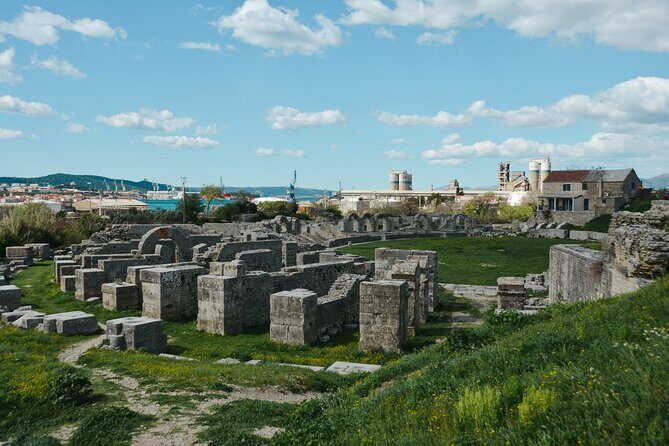
The highlight is Amphitheatre Salona, visited for about 30 minutes. It’s described as relatively well preserved. That matters, because the amphitheatre is where your eyes naturally lock in. It’s the structure that makes the city feel like a capital instead of just scattered ruins.
There’s also a specific historical note that makes the place more personal: Venetians removed most stones to build churches in Venice. You’ll feel that “why is it missing?” question in your mind while looking around. It’s great to have the explanation attached rather than guessing.
What you’ll likely enjoy most here is the sense of scale. Even without a full “Roman sports broadcast” in your imagination, the space is big enough that you can picture crowd movement, noise, and spectacle.
Price and Time: Is $203.50 Per Person Worth It?
At $203.50 per person for a private, English-guided tour lasting about 2 hours 30 minutes, you’re paying for two things: interpretation and efficiency.
This tour isn’t trying to sell you a single monument. It builds a layered route through Roman and early Christian Salona in a fixed time box. That’s where private guidance becomes valuable. Without it, it’s easy to walk among sites and miss how they connect.
For value, I’d think like this:
- If you want to spend your limited time seeing many different parts of the ancient city, this format saves you from the hard work of figuring out what matters.
- If you’re mostly interested in one or two big sights, you might feel the price is steep for shorter exposure.
My advice: if you like guided context and you want the amphitheatre plus the surrounding story (necropolis, baths, gate details, forum area), you’ll feel the cost makes more sense.
Also note that this experience is commonly booked about 84 days in advance. If your dates are fixed around peak season, booking sooner can help you secure a time.
Weather and Comfort: The One Real Variable
Good weather is required for this experience. That’s a big deal here because so much is outside on uneven ancient terrain.
If you visit in hot sun, bring water and take shade breaks when your guide offers them. If skies look risky, you’ll likely want a flexible mindset—this tour is built to work when visibility and walking conditions are decent.
Service animals are allowed, and the tour is near public transportation, which can make it easier to plan your day around it.
Who This Private Salona Tour Suits Best
This fits especially well if you:
- want a clear storyline instead of a scattered ruin tour,
- enjoy Roman cities but also want early Christian context,
- appreciate a guide steering you through short stops so you don’t waste time guessing.
It’s also a good choice if you’re traveling with someone who prefers structure. You’ll get a consistent route, and the pace is designed for making multiple sites digestible in one afternoon or morning.
If you’re the type who wants long free time to wander without explanations, this might feel a bit tight. The stops are intentionally short, with the amphitheatre getting the longer look.
Should You Book This Salona and Amphitheatre Private Tour?
Yes—if you want more than photos and want the connections between Roman civic life and early Christian burial spaces. The amphitheatre is the big payoff, but the route makes it meaningful by building context first.
Book it if you enjoy:
- having Ivan (the named guide) explain what you’re seeing and why it matters,
- moving through many sites efficiently,
- getting those physical details like the Porta Caesarea chariot ruts that make ruins feel real.
Don’t book it if weather is uncertain and you’re unwilling to adjust, or if you’d rather focus on fewer stops with more independent wandering.
Overall, this is a strong value when you treat it as a guided history walk you can’t easily replicate on your own. The time is tight, the pacing works, and the amphitheatre lands with impact.
FAQ
How long is the Salona and Amphitheatre private guided tour?
It’s about 2 hours 30 minutes.
Is the tour offered in English?
Yes, it’s offered in English.
Is this a private tour?
Yes. Only your group will participate.
What ticket costs should I expect for Ancient Salona?
The entrance fee to the open-air museum at Ancient Salona is about €10 for adults and is listed as not included. Other stops in the route are listed as free.
Does it include a mobile ticket?
Yes. The tour features a mobile ticket.
Where does the tour start?
The start is at Salona main entrance, Ul. don Frane Bulića 58, 21210, Solin, Croatia.
Is the experience dependent on weather?
Yes. It requires good weather, and if it’s canceled due to poor weather you’ll be offered a different date or a full refund.
Can I cancel for a full refund?
Free cancellation is available up to 24 hours in advance for a full refund.