REVIEW · HISTORICAL TOURS
Private History and Trivia Walking Tour by a Local Guide
Book on Viator →Operated by Lingua Tours · Bookable on Viator
A great old-city walk is part history lesson, part street map. This private Split tour is built around Diocletian’s Palace and the landmark sights that explain how Split became Split. You get a tight, 1 hour 45 minute route that works well when your time in the city is short.
I like two things a lot: the guide’s humor + in-depth answers make the facts easier to remember, and the walk format lets you reach spots that bus tours usually can’t manage—especially inside the Palace area and through the cramped lanes. One possible drawback: it’s a whistle-stop route, so if you want long museum time or a slow pace with lots of stops to sit and watch, this may feel brisk.
In This Review
- Key things to know before you go
- Why a private history-and-trivia walk makes sense in Split
- Riva Harbor: where Diocletian’s Palace meets the waterfront
- Entering Diocletian’s Palace substructures through the Bronze Gate
- Peristyle Square, St Domnius, and the Temple of Jupiter story
- Fruit’s Square and the tight streets buses can’t reach
- Narodni trg and Zeljezna Vrata: gates that tell the city’s power shifts
- City Museum at Papalić Palace and the Game of Thrones connection
- The Golden Gate, Grgur Nin, and St Arnir’s bell tower
- Marmontova Ulica and finishing with big views over theatre and church
- What you’re really paying for: value of $53.95 and a 1:45 route
- Tips to get the most out of the walk
- Who this tour fits best (and who should choose another option)
- Should you book this Split private history and trivia tour?
- FAQ
- How long is the Private History and Trivia Walking Tour in Split?
- Is this a private tour?
- What’s the maximum group size?
- What languages are guides available in?
- Where do we meet, and where does the tour end?
- Are entrance tickets included for the stops?
- Are service animals allowed?
- Is cancellation free?
Key things to know before you go
- Private, small group feel: it’s your party only, with a maximum of 15 people.
- Real Palace access: you’ll enter Diocletian Palace substructures through the Bronze Gate area.
- Christian-into-ancient stories: Temple of Jupiter and St Domnius show how buildings changed with faith.
- Narrow streets, not just big squares: Fruit’s Square and the tight route between landmarks give you texture.
- Town orientation by walking: you’ll finish overlooking Marmontova Street views and key institutions.
Why a private history-and-trivia walk makes sense in Split
Split can feel like a maze at first. The old core is layered: Roman walls are still there, medieval life grew inside them, and later palaces and squares added their own chapter. This tour helps you connect the dots fast, so you can wander afterward with a much clearer sense of what you’re looking at.
What makes it especially useful is the pace and planning. It’s long enough to hit the big hitters—Diocletian’s Palace, St Domnius, and multiple gates—but short enough that you’re not stuck all afternoon. If you like trivia that actually explains what you’re seeing, this kind of tour is a strong starting move.
The private setup also matters. With a guide focused on your group, you can ask questions and steer the conversation toward the things you care about most, instead of waiting your turn in a large crowd.
You can also read our reviews of more walking tours in Split

Riva Harbor: where Diocletian’s Palace meets the waterfront
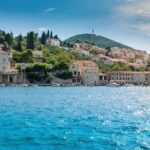
The tour begins on the promenade at Obala Hrvatskog narodnog preporoda 22, near Riva Harbor. Standing here, you get a first visual lesson: the southern wall of Diocletian’s Palace isn’t hidden behind museum glass—it literally borders the harbor world.
From this spot, the guide points out the harbor views and the palace coastline angles—east and west promenades. It’s a quick way to learn the geography of Split without needing a map app. Even before you start walking into the Palace, you’re building a mental model of where everything sits.
Practical tip: wear shoes with solid grip. You’ll be on foot for a while, and Split’s historic streets are not designed for slow, careful strolling.
Entering Diocletian’s Palace substructures through the Bronze Gate
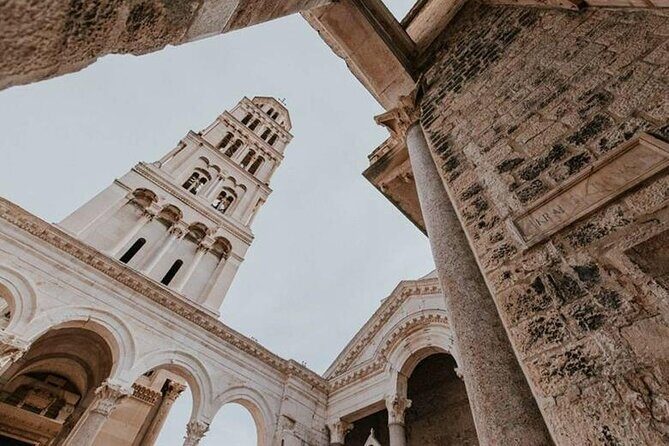
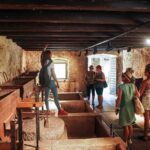
Next comes one of the best “how is that still here?” moments: you go inside the Diocletian Palace substructures via the southern entrance near the Bronze Gate. This is the kind of stop that feels different from a typical exterior-only city walk.
Substructures are where the Palace’s daily mechanics start to make sense. You’re not just looking at stones—you’re hearing about what those spaces did through different eras. The goal is to understand how Diocletian’s Palace wasn’t only a monument; it was a working environment that later generations had to adapt.
A small heads-up: these are indoor or covered stone areas, so lighting can be variable. If you like photos, give your eyes a moment to adjust before you start shooting.
Peristyle Square, St Domnius, and the Temple of Jupiter story
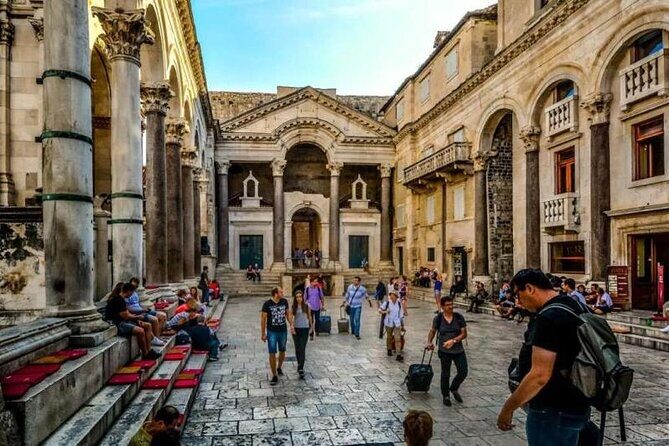
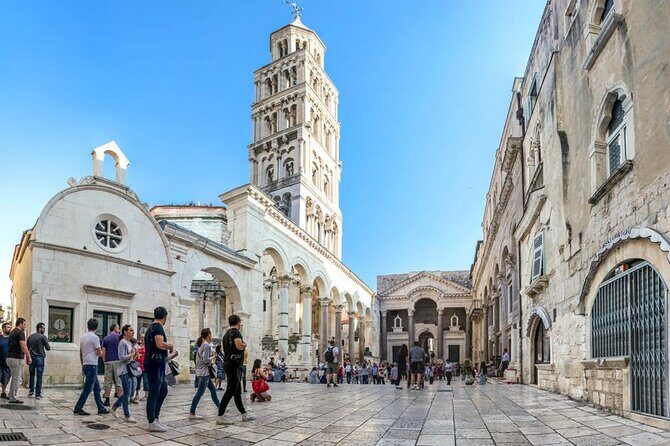
After the substructures, you reach the heart of the Palace complex: the Peristyle—the central ancient square. This is where the guide gives you the big framework. You learn why this square mattered culturally and historically, and how it anchored the Palace layout.
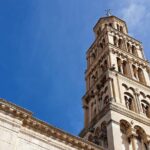
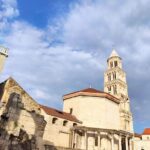
Then it gets even more interesting because you watch a single site evolve through time. The tour moves to the Cathedral of Saint Domnius, where the guide explains the emperor’s original role as well as how the mausoleum concept was turned into a cathedral. You’ll also hear construction-style details that connect the Cathedral and the nearby Bell Tower.
From there, you go to the Temple of Jupiter. The point here isn’t just that it’s Roman; it’s that it was repurposed as Christianity spread. You’ll also notice the sphinx in front—an object that visually interrupts the expected flow of Roman-vs-Christian narratives and makes you pay attention.
If you like architecture, this portion is the payoff. You’ll see how the same stones can carry new meanings without erasing old ones.
Fruit’s Square and the tight streets buses can’t reach
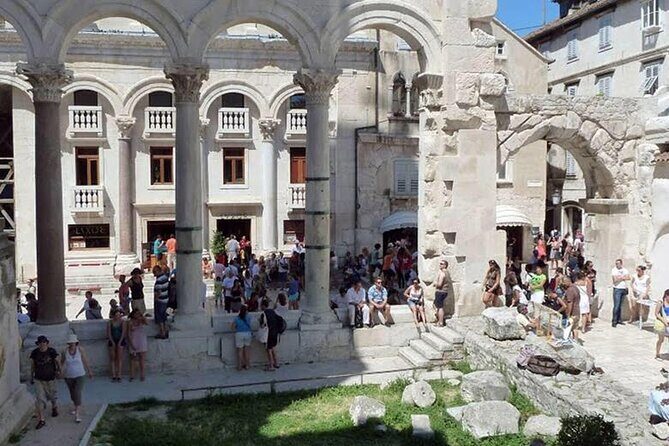
Now you transition from the monumental core to the lived-in feel of old Split. You pass through some of the tightest streets, including the famous narrow passage known as Pusti me Proć. This kind of lane is where the city stops feeling like a sightseeing checklist and starts feeling like a real place people moved through every day.
You reach Fruit’s Square (Trg Brace Radic), where the guide talks about the development of Split—more specifically, how it grew and what didn’t happen the way you might expect. Then you’ll spot the statue of Marko Marulić, described as the father of Croatian literature, right there in the square’s context.
From the square, the route also includes reminders of how different families shaped the streets: you pass the Milesi family palace from the 17th century. It’s not about name-dropping. It’s about learning how wealth, identity, and architecture moved into the city fabric.
Possible drawback here: the route through narrow streets can feel crowded if your group overlaps with other foot traffic. You can still enjoy it, but keep your pace flexible.
You can also read our reviews of more guided tours in Split




Narodni trg and Zeljezna Vrata: gates that tell the city’s power shifts
Next you head to Narodni trg, Split’s main square. The guide explains the square’s historical development—how it became central as the town expanded. This is a good moment to pause, look around, and understand the “why here?” of the urban layout.
As you move across the square area, you pass palaces of different noble lines, including palaces once tied to families connected to places like Korčula. You’ll also see the old City Hall and other renovated or notable buildings near the square. These aren’t random detours; they’re the visual timeline of who ran civic life and why the square stayed important.
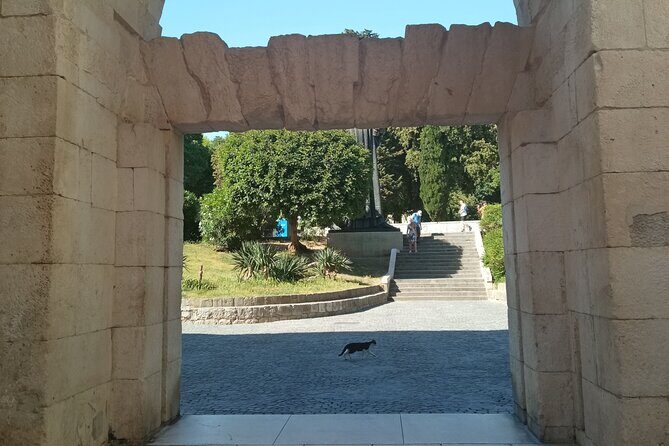
Then you continue eastward toward the western gate of Diocletian’s Palace, the Zeljezna Vrata—the Iron Gate. This is one of those stops where the guide’s storytelling makes objects feel alive. You’ll hear about the gate’s history and the different activities that took place there. Even if you’re not an architecture geek, gates are useful. They show boundaries and access—how people moved in and out.
And you keep seeing palace walls and facades along the way, including additional family palaces such as a Cindro family palace from the 17th century and an Italian Augubio family palace from the 15th century.
City Museum at Papalić Palace and the Game of Thrones connection
After the gates and palaces, the tour brings you to the City Museum of Split, located in Papalic Palace. The stop is brief, but it works because it anchors all the talk about past life to a physical location you can later visit more fully if you want.
There’s also a pop-culture angle for Game of Thrones fans. The tour notes that a well-known, if bloody, scene is associated with the area in front of this palace. Even if you’re not watching the show, it’s a reminder that filmmakers often choose locations because they already look like history.
Practical note: the stop is short, so treat it as a “meet the place” moment. If you want museum depth, you’ll likely need a separate visit.
The Golden Gate, Grgur Nin, and St Arnir’s bell tower
You then reach the Golden Gate, described as the northern entrance to Diocletian’s Palace and one of its most decorated. This is a strong photo stop because you get that Roman craft feeling: stonework that looks purposeful, not accidental.
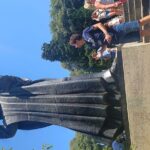
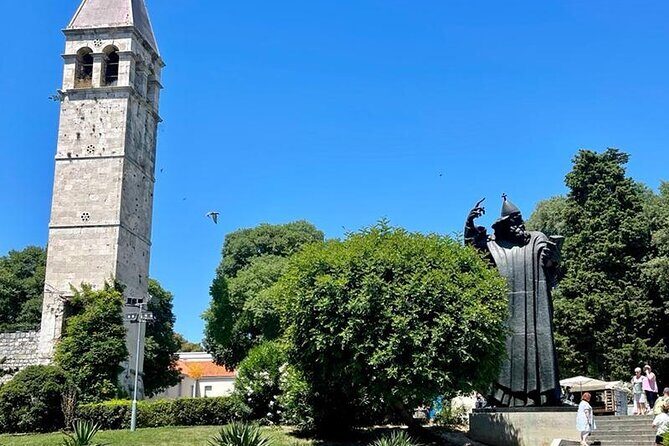
Opposite the northern gate is the Grgur Ninski statue, a work by Croatian sculptor Ivan Meštrović. The guide explains why Bishop Grgur is such an important figure—another “story behind the statue” moment that helps you look beyond the tourist icon.
From there you step next to the Bell Tower of St. Arnir, along with the chapel of Saint Arnir and remnants of an early Christian church. It’s a compact block, but it ties together themes from earlier stops: Roman structure, Christian adaptation, and how Split reused space instead of starting over.
If you’re walking with kids or a mixed-age group, this segment is easy to like because it alternates between viewpoints and concrete landmarks.
Marmontova Ulica and finishing with big views over theatre and church
The tour ends up on Marmontova Ulica, finishing at the top of the street with views over the Croatian National Theater and the Monastery and Church of Our Lady of Health. Ending with an overlook matters. It gives your brain a reset after lots of narrow lanes and close-up details.
This final stretch is also a good time to ask your guide for practical advice. The tour includes the kind of “where should I go next?” guidance that can save you time later, especially if you want to keep exploring by foot.
What you’re really paying for: value of $53.95 and a 1:45 route
At $53.95 per person, this isn’t a bargain tour. But it often feels fair because you’re paying for three things that add up in a short time: a private guide, the walking-to-access locations factor, and interpretation—not just seeing stones, but getting the story that makes them click.
A good way to judge value here is to compare this format to a hop-on/hop-off or standard group bus tour. Buses can cover distance; walking with a guide can cover understanding. And because the group is capped (maximum of 15) while still being private to your party, you get more room for questions than you would on a large guided group.
Duration is also part of the value equation. 1 hour 45 minutes means you can do this early in your stay, then build the rest of your day with confidence. If you wait until your last day, you might miss the benefit of having the map in your head.
Tips to get the most out of the walk
Here are a few ways to make this tour pay off even more:
- Go in with at least one curiosity question: Roman life, Christian changes, or how civic power shifted.
- Keep your camera ready, but don’t rush every photo. Some of the best moments are at viewpoints like the Marmontova finish.
- Save your museum plans for after the tour if you want extra time—this route is meant to orient you.
- If you’re traveling with kids, the schedule’s short stops can work well, as long as you keep expectations realistic about walking time.
Also, the guide can handle multiple languages (English, French, German, Spanish, Italian). If you’re not fully comfortable with the language you’re traveling in, picking a tour in your strongest language is worth it.
Who this tour fits best (and who should choose another option)
This is ideal for you if:
- You want a smart first visit to Split’s old core
- You like historical stories with trivia that connects to specific places
- You’re time-tight and don’t want to plan the day block by block
- You enjoy walking and don’t mind a brisk pace
You might want a slower or longer option if:
- You prefer long indoor stops and museum time
- You get overwhelmed by a dense schedule of gates, squares, and buildings in one afternoon
- You’d rather explore on your own after a light orientation
The tour’s “private to your group” setup is a plus for anyone who doesn’t like being rushed by crowds.
Should you book this Split private history and trivia tour?
Yes, if you’re trying to turn a quick visit into real understanding. This one does a good job of combining landmark access with the kind of street-level context that makes Split feel coherent. The structure—Palace interiors, Peristyle, St Domnius, Temple of Jupiter, then squares and gates—keeps the story moving instead of getting stuck in one theme.
If you hate fast pacing, you may feel a bit squeezed. But for most people, the time here is a strength: it’s long enough to matter, and short enough to leave you free to keep exploring afterward with a clearer sense of what’s where.
FAQ
How long is the Private History and Trivia Walking Tour in Split?
The tour lasts about 1 hour 45 minutes.
Is this a private tour?
Yes. It’s private to your group only.
What’s the maximum group size?
The maximum group size is 15 persons.
What languages are guides available in?
The guide speaks English, French, German, Spanish, and Italian.
Where do we meet, and where does the tour end?
You meet at Obala Hrvatskog narodnog preporoda 22, 21000 Split, Croatia, and the tour ends back at the same meeting point.
Are entrance tickets included for the stops?
The tour details list each stop with admission ticket free, so you shouldn’t need separate paid entry fees for the included stops.
Are service animals allowed?
Yes, service animals are allowed.
Is cancellation free?
Yes. You can cancel for a full refund up to 24 hours in advance. If you cancel less than 24 hours before the start time, the amount paid is not refunded.