REVIEW · PRIVATE
Experience Split With Local Professional Historian – Private
Book on Viator →Operated by Pomalo tours · Bookable on Viator
Split’s old stones talk.
This private, English-speaking 2-hour Split history walk connects major landmarks—Golden Gate, Gregory of Nin, Diocletian’s Palace, Riva, and Pjaca—with clear explanations you can actually use while you wander. You get 3D reconstruction images to help you picture what’s gone, plus a master’s-trained local historian to keep the story straight.
What I like most is how practical the route feels. You start at the Golden Gate and build your way through Diocletian’s Palace in a logical sequence, so the old city makes sense fast. I also really enjoy the guide’s focus on “how life worked,” not just dates—so the Palace layout, dining spaces, and changing religious influence feel real.
One possible drawback: this is an outside-and-in-plain-view kind of tour. Even though you’ll see major Roman and early Christian landmarks, the experience is short (about 2 hours) and you’re not going inside places that require paid admission.
In This Review
- Key takeaways before you go
- Golden Gate start: get your bearings fast
- Gregory of Nin statue: the person behind the spotlight
- Diocletian’s Palace: how Roman planning became a medieval city
- Peristyle: the courtyard that controlled people
- Triclinium and the cellars: where the story gets tangible
- Jupiter’s Temple (outside): religion as part of the layout
- St. Domnius Cathedral (outside): what to expect if you go in later
- Vestibulum: the private entry you can’t ignore
- Riva Harbor: the promenade that grew into a meeting place
- Fruit Square and Pjaca: small stops, real city energy
- Timing and pace: how this 2-hour plan really works
- Price and value: $156.21 per group that can make sense
- Practical tips to get the most from the walk
- Should you book this Split Diocletian’s Palace historian tour?
- FAQ
- How long is the Split private historian tour?
- Is this tour private?
- What language is the tour offered in?
- What’s included in the price?
- Do I need to buy admission tickets for the stops?
- Where does the tour start and end?
- What happens if the weather is bad?
Key takeaways before you go
- Private with a historian: you’re not stuck with a megaphone and generic facts.
- 3D recon help: the display book makes it easier to understand missing structures and palace functions.
- Golden Gate to Pjaca: a compact route that links Split’s Roman core to the later city grid.
- Religion explained in layers: Jupiter Temple and St. Domnius are treated as part of a bigger transition.
- Flexible pacing: guides have adjusted for late arrivals and even mobility needs, keeping the tour on track.
- Mostly no admission friction: stops are set up so the guided portions don’t hinge on ticketed entry.
Golden Gate start: get your bearings fast
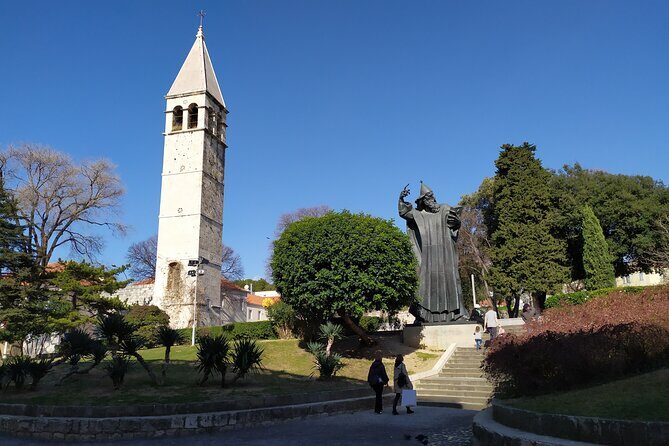
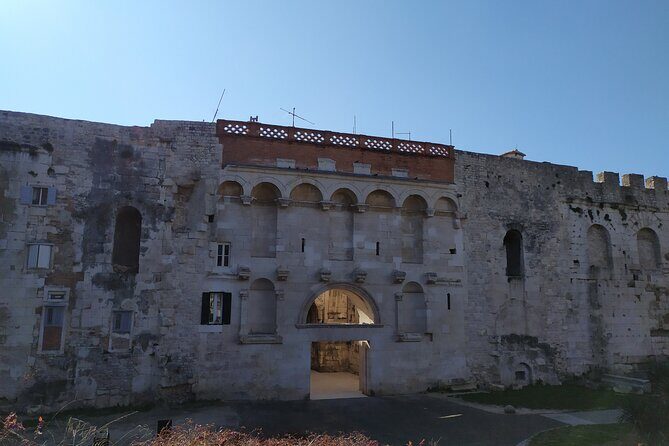
Your tour meets at Golden Gate, at Dioklecijanova 7. This matters more than it sounds. Golden Gate sits on the northern side of Diocletian’s Palace, and facing it you can immediately “read” the old city: Roman defenses on one side, and major medieval and later landmarks on the other.
Golden Gate isn’t flashy in a cartoon way. It’s stone, yes, but it’s also a key to the whole place. You’ll hear why it was built, why it’s still a landmark, and why Split grew around this Roman core instead of replacing it. You’re also standing across from Gregory of Nin, which sets up the next stop perfectly.
This is a strong first move because it turns your brain on early. By the time you reach the statue area, you’re not just looking at sights—you understand how the city is organized around Diocletian’s Palace walls.
You can also read our reviews of more private tours in Split


Gregory of Nin statue: the person behind the spotlight
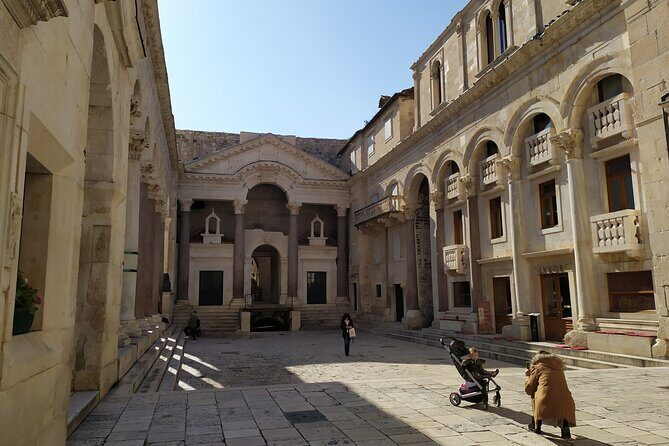
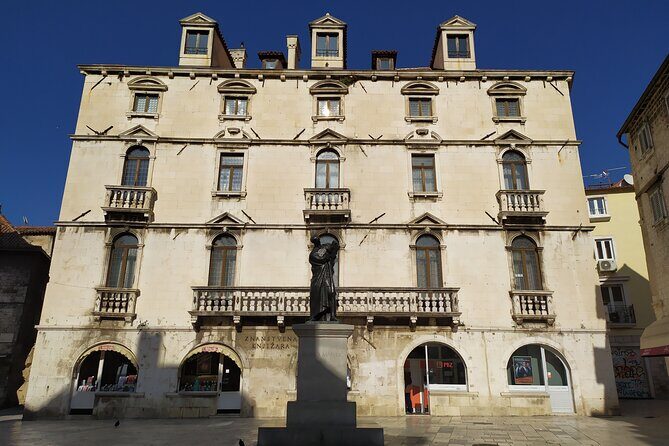
From Golden Gate, the route goes to the Grgur Ninski statue (Gregory of Nin). This is where the tour shifts from architecture to people, and it’s a nice change of pace.
You’ll get the story of Gregory of Nin—why he mattered historically, plus fun, concrete details tied to the statue itself. The guide also explains the monument dedicated to him and who created it. Even if you don’t know anything about him going in, the explanation gives you context for why this figure is still honored in Split today.
Practical tip: if you’re photographing, this is a good place to slow down. The statue and the Roman-palace setting help you build a “mental map” of the old town—where power stood, where people walked, and where you’re standing right now in the same urban footprint.
Diocletian’s Palace: how Roman planning became a medieval city
Next comes the main event: Palazzo di Diocleziano (Diocletian’s Palace). This is the heart of Split’s historic center, and it’s still one of the best-preserved Roman palace complexes of its kind. The guide uses that fact to do something useful: connect imperial ambition with daily life.
You’ll hear about Diocletian as an emperor, then walk through the most important parts of the Palace that shape what you’ll notice while you roam afterward. The tour specifically routes you past and around major features such as:
- Peristyle
- Jupiter’s Temple (outside)
- Diocletian’s Cellars (central substructure)
- Triclinium
- Mausoleum / Cathedral (outside)
What makes this portion valuable is the “transition” talk. You’ll learn how the Palace didn’t just stay Roman forever. Over time, it became a medieval city with its own feel—different rhythms, different needs, different ways of using the spaces. That’s exactly what you want when you arrive in Split: a guide who helps you see continuity, not a history lecture that stops at the Roman era.
Peristyle: the courtyard that controlled people
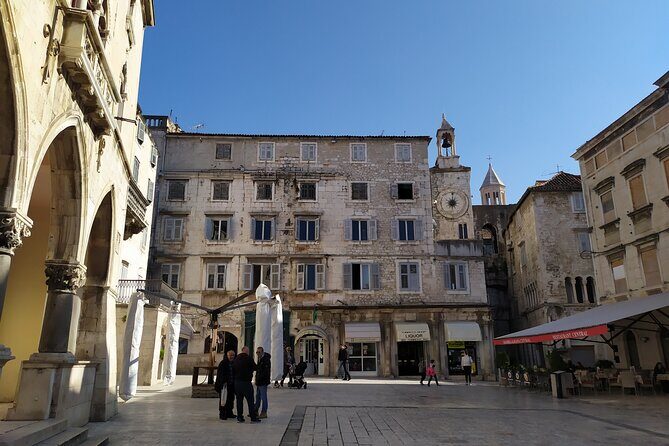
The tour then focuses on the Peristyle of Diocletian’s Palace, standing in the central space that anchors the layout. This part is more than a pretty courtyard view. You’ll learn its function: it’s a connector and divider at the same time, separating who could go where and shaping movement around the Emperor.
While you stand there, you get a clear sense of orientation. The guide explains how the Palace life operated from that central point—how it would have felt to move through these spaces when the hierarchy mattered.
A key detail here is how the guide connects the space to later religious change. You’ll hear about transitions of buildings and life as Christianity expanded, which helps you understand why you see certain religious structures and adaptations within the Roman frame.
Triclinium and the cellars: where the story gets tangible
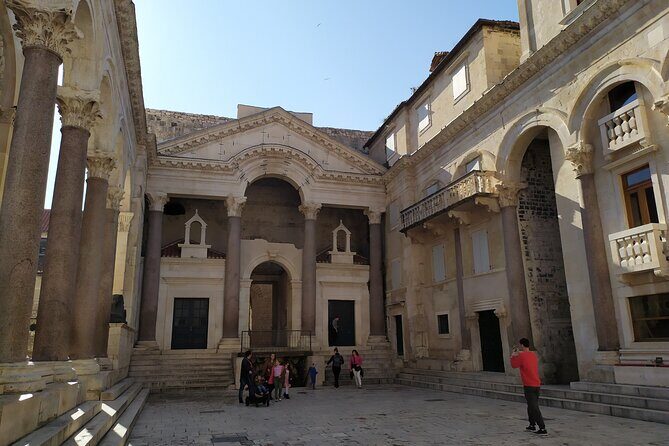
From Peristyle you move toward the central area of the Palace cellars, then you’ll check the Triclinium area.
Even if you’re not a “Roman stuff” person, this is where the tour earns its keep. The guide explains how the cellars were used during different periods and why they became important for Split’s development—then brings it back to what they mean now. You’re not just admiring walls; you’re learning what the spaces did.
At Triclinium, the guide talks about the eating habits of the Emperor and Romans in general, plus how the Emperor’s dining room was organized. That kind of detail makes the architecture click. Once you understand where and how meals happened, you’ll notice layout clues you’d otherwise miss.
And because you’re given 3D reconstruction images via a display book, you’re not stuck guessing about what used to be there. That tool makes the walking parts smoother, especially in a site where some elements are hard to visualize from street level.




Jupiter’s Temple (outside): religion as part of the layout
Next is the Temple of Jupiter, viewed from the outside. It’s short—about ten minutes—but it’s timed well. After the Triclinium and cellars, the temple helps you understand the larger role religion played in Roman residences.
The guide explains why temples for honoring gods weren’t optional add-ons. They were woven into the idea of power and daily order. Standing there from the outside, you’ll get a sense of what the temple represented without requiring you to pay to step inside.
This stop is also useful because it sets up the next big contrast: how the religious world shifted as centuries passed.
St. Domnius Cathedral (outside): what to expect if you go in later
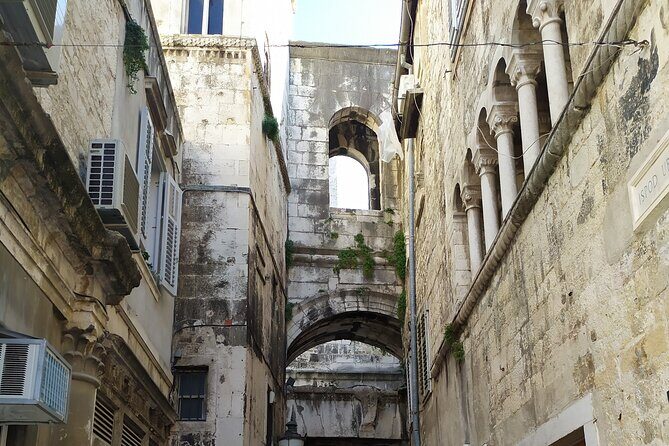
The tour then heads to the Cathedral of Saint Domnius (St. Domnius), again from the outside. You’ll be shown significant parts of the cathedral and given story and facts tied to it.
Here’s the smart approach: you’re warned about interesting points to look for inside if you decide to visit on your own afterward. That way, you’re not wasting your limited time trying to do everything at once during the guided walk.
If you like to plan your own museum-time, this is a win. You leave with a short list in your head, which makes a follow-up visit feel more like an informed rewatch than a random walk-through.
Vestibulum: the private entry you can’t ignore
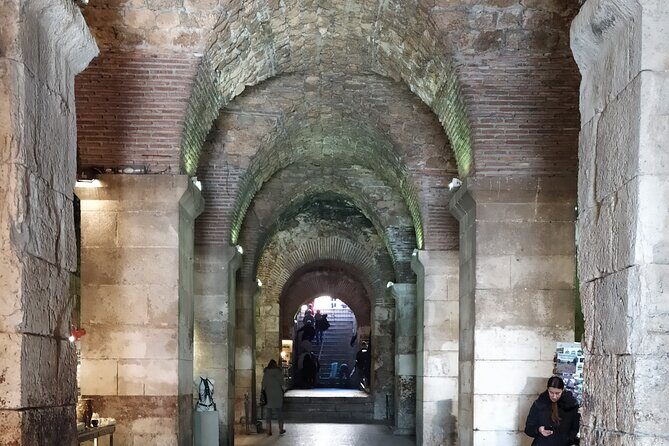
One of the more intriguing stops is the Vestibulum of Diocletian’s Palace—the pre-entrance to the Emperor’s private chambers.
The guide explains what it looked like and what it was for, and the emphasis here is on importance. Even if you’re not a history architect, you’ll get the “why” quickly: this wasn’t a casual passage. It was part of controlled access and status, decorated to match the function.
This is the kind of stop that makes the tour feel more than a highlights reel. You’re seeing how even the waiting space, not just the main rooms, belonged to the Palace’s hierarchy.
Riva Harbor: the promenade that grew into a meeting place
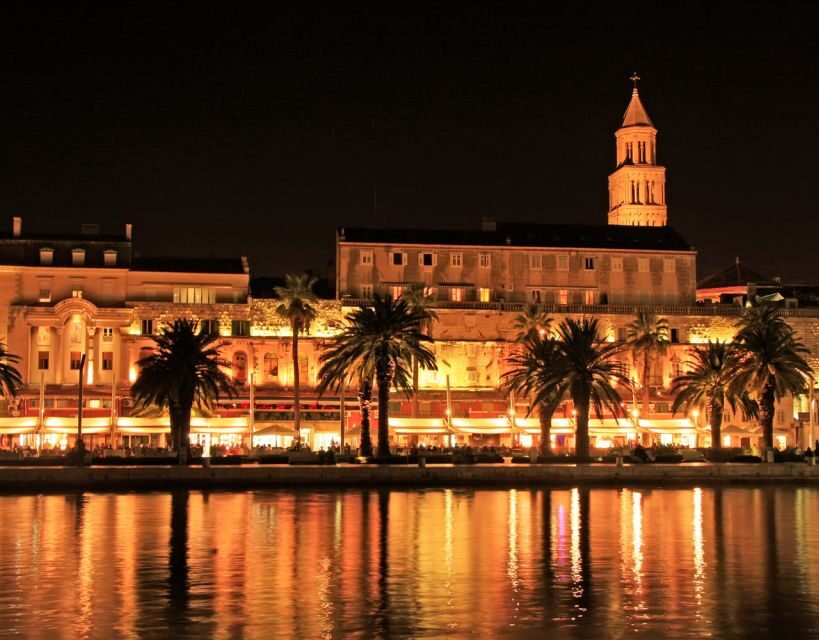
After the Palace world, you shift to Riva Harbor, the main city promenade. The guide explains how Riva was built over centuries and why it became important for locals—central to everyday life, not just sightseeing.
This is one of those stops I appreciate because it helps you understand Split’s present-day “stage.” You’re not only learning about what Roman emperors did. You’re also learning how the city’s social life found its rhythm along the waterfront.
Even if you’re only here for a short visit, Riva is where you’ll likely return later. This tour gives you context for why it feels so practical: people gather here because the space makes sense.
Fruit Square and Pjaca: small stops, real city energy
The walk continues to Fruit’s Square (Trg Brace Radic). It’s small, charming, and it has a naming story tied to the Fruit Square name. The guide also points out the important monument in the middle and the surrounding sights that define the square.
Then you finish at Pjaca / People’s Square, known as Pjaca. This square has been a center of city happening from medieval times to now. The guide explains its story and the surrounding buildings, including the old City Hall area.
What I like about ending here is the clean handoff. By the time you step into Pjaca Square, you have two advantages:
1) you know what Roman foundation you’re standing on at a higher level
2) you know where Split’s “life today” tends to concentrate
From there, the tour wraps and you can head off to whatever fits your evening—dinner, a relaxed waterfront walk, or a self-guided look at the cathedral area.
Timing and pace: how this 2-hour plan really works
The tour runs about 2 hours and is offered in English. It’s designed as a compact circuit with several short stops, which keeps momentum up. Each stop gets enough time for orientation and key takeaways, but not so long that you feel trapped.
The meeting point is Golden Gate (Dioklecijanova 7) and the tour ends at Narodni trg 16 / Pjaca (People’s Square). The schedule listed is Monday–Friday, 5:00 PM–7:00 PM.
One more practical note: the experience requires good weather. If conditions aren’t suitable, you’ll be offered a different date or a full refund. If you can, plan this for a day when you’re not locked into a tight evening plan—just gives you breathing room.
Price and value: $156.21 per group that can make sense
The price is $156.21 per group (up to 15). In other words, it’s priced as a group rate, not per person.
So the value depends on how you’re traveling:
- If you’re a couple or small group, this can still be a fair deal because you’re paying for a private historian rather than a seat on a large group bus tour.
- If you’re traveling with friends and can split the total, the cost drops fast and the private element becomes the standout bargain.
The other value factor: you get flexible starting time by contacting ahead of time. That flexibility matters in Split, where plans often get nudged by timing, sunset, and dinner reservations.
Also, the tour includes:
- a local guide with a master’s degree in history
- 3D reconstruction images & pictures via display book
- the private/group format
No admission tickets are listed as included, which matters because it keeps expectations clear: you’ll focus on what you can see and learn during the guided portions without assuming entry fees are part of the price.
Practical tips to get the most from the walk
- Wear comfortable shoes. You’ll be moving through old-town streets and Palace areas, where surfaces can be uneven.
- Bring a phone or camera, but also slow down at the Palace viewpoints. The guide’s explanations land best when you pause and look.
- If you have mobility needs or need seating breaks, say so early. The tour is built around short segments, and the guide has shown they can adjust pace to keep people comfortable.
- If you plan to visit the cathedral interior after the tour, keep your expectations simple: you’ll get “what to watch for,” not a full inside-program.
Should you book this Split Diocletian’s Palace historian tour?
Yes, if you want a high-signal introduction to Split’s Roman core and early Christian layers without wasting time. This tour is especially good for first-timers who want the city to make sense: Golden Gate gives you orientation, Diocletian’s Palace gives you structure, and Riva/Pjaca gives you the human scale.
I’d skip it or adjust expectations if your main goal is deep ticketed museum time or a long indoor itinerary. This isn’t built to be a full-day “everything in Split” program. It’s built to teach you how the city reads in two hours.
If you’re choosing between a generic walking tour and something led by a trained local historian, this one has the edge: it’s compact, story-driven, and it uses tools like 3D recon to make the Palace feel understandable, not confusing.
FAQ
How long is the Split private historian tour?
It lasts about 2 hours.
Is this tour private?
Yes. It’s a private tour/activity, and only your group participates. The group size is listed as up to 15.
What language is the tour offered in?
The tour is offered in English.
What’s included in the price?
You get a local guide with a master’s degree in history, and the tour uses 3D reconstruction images via a display book. A mobile ticket is also provided. Starting time can be flexible if you contact ahead.
Do I need to buy admission tickets for the stops?
No admission tickets are included. The stops listed are marked as admission ticket free, but if you want to visit any interiors afterward, you may need to arrange tickets on your own.
Where does the tour start and end?
It starts at Golden Gate, Dioklecijanova 7, 21000 Split, Croatia, and ends at Narodni trg 16 / People’s Square (Pjaca Square), 21000 Split, Croatia.
What happens if the weather is bad?
The experience requires good weather. If it’s canceled due to poor weather, you’ll be offered a different date or a full refund.